Equality cases and every-copy results for the Werner endpoint inequality
Abstract
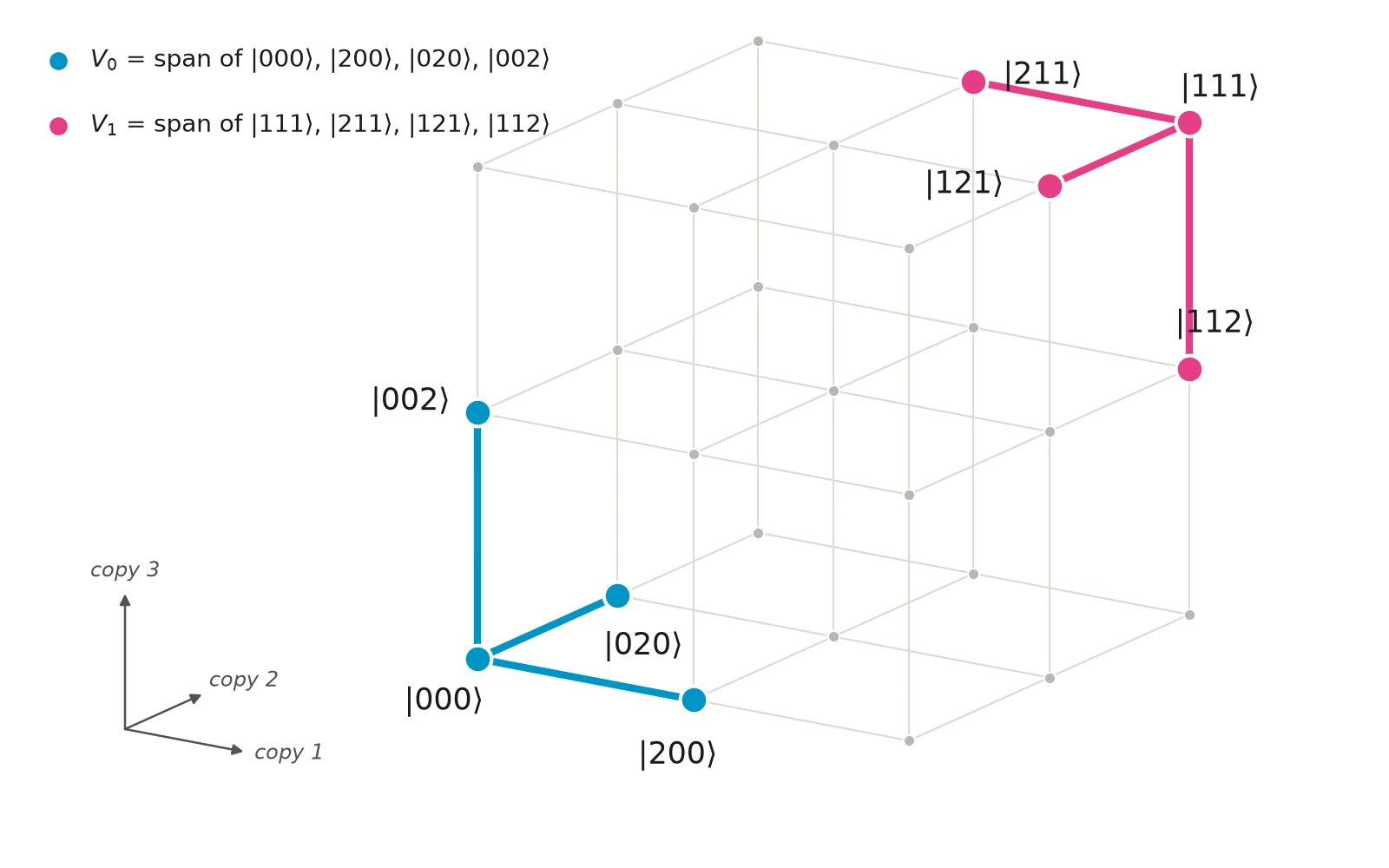
Whether every entangled state with a non-positive partial transpose (NPT) is distillable reduces to the case of the Werner states ρ(d,α) = (I + αF)/(d² + αd), where F is the swap. For d ≥ 3 and −1/2 ≤ α < −1/d these states are NPT but one-copy undistillable. Write a vector on k copies as a matrix C, and let Tr_J trace out the copies in J. By the Schmidt-rank criterion of DiVincenzo et al. and Dür et al. (2000), as rewritten by P. Costa Rico (2025), ρ(d,α) is k-copy undistillable exactly when Σ_J α^|J| ‖Tr_J C‖² ≥ 0 for every vector of Schmidt rank at most two on k copies. At α = −1/2 we call this the endpoint inequality. It was proved independently for two copies by Fu et al., Fraser et al., Song and Chen, and Bharti et al. (2026), and for three copies by a computer-assisted proof in the companion record doi:10.5281/zenodo.23604343. If it held for every k, NPT bound entanglement would exist. We describe its equality cases for two copies and where it could first fail, and we prove it on two classes of matrices, one for every number of copies and one for four copies. For two copies we prove that every equality case, that is, every nonzero C of rank at most two with equality in the endpoint inequality, has rank two and that the ranges of C and C* lie in products of two-dimensional single-copy subspaces. We obtain this by following the equality cases through Song and Chen's elementary proof of the two-copy inequality. Every known equality case, for any number of copies, has a range with a reduced state of rank at most two on some copy. We also show that a first failure would come with larger reduced states: if the endpoint inequality holds for k − 1 copies but fails for k, then for some α > −1/2 the inequality still holds, with equality at a nonzero C whose range has reduced states of rank at least three on every copy. This rests on a copy-removal lemma built on the separable ball of Gurvits and Barnum. We prove the endpoint inequality, for every k and d ≥ 3, for the matrices C whose range is spanned by a vector f_0 of V_0 and a vector f_1 of V_1 and whose co-range (the range of C*) is arbitrary. Here V_c is spanned by |c⟩^⊗k and the k vectors obtained from it by replacing one factor with |2⟩, for orthonormal |0⟩, |1⟩, |2⟩; for generic f_0 and f_1 the projector onto the range has reduced states of rank three on every copy, as a first failure would require. So no vector of this kind witnesses distillability of ρ(d,−1/2). Schur complements reduce the claim to a quadratic form; an induction on the number of copies then completes the argument. For four copies we establish the endpoint inequality in every dimension for all C whose range and co-range lie in one two-dimensional subspace. This class contains all normal matrices of rank two, for which Wu and Zou had proved the three-copy case (arXiv:2608.02647). Here we restrict the quartic moment relaxation used in the companion record to this class, where it involves the moments of a single vector; one exact certificate, together with an embedding into larger dimensions, then covers every dimension. For d = 3 the theorem is also proved in Lean 4 with Mathlib, in the package release_lean_commonplane. Some data checks in that proof are evaluated by compiled code (native_decide). For general C the endpoint inequality remains open from four copies on.
In plain words
Distillation turns many noisy entangled pairs of particles into fewer, nearly perfect ones. A simple test, the partial transpose, flags some states as entangled; whether every state it flags can be distilled has been an open question since the late 1990s. The answer would be no if one particular noisy state, a Werner state, could not be distilled from any number of copies. For each number of copies this comes down to an inequality, proved for two copies by others and, in the author’s companion paper, for three. This paper shows what the two-copy cases of exact equality must look like, and proves the inequality for any number of copies on one family of test cases and for four copies on another. The question itself remains open.