Undistillability of Werner states from three, four and five copies
In plain words
Teleportation and some forms of quantum cryptography use entangled particle pairs. A process called distillation turns many noisy pairs into fewer, nearly perfect ones. A simple test, the partial transpose, reveals entanglement in many states. Whether every state it flags can be distilled has been open since the late 1990s. The question comes down to one family, the Werner states. In July 2026, four groups proved that two copies of a Werner state can be distilled only when one copy can. The paper shows that three copies do no better, however many basic states each particle has.
Abstract
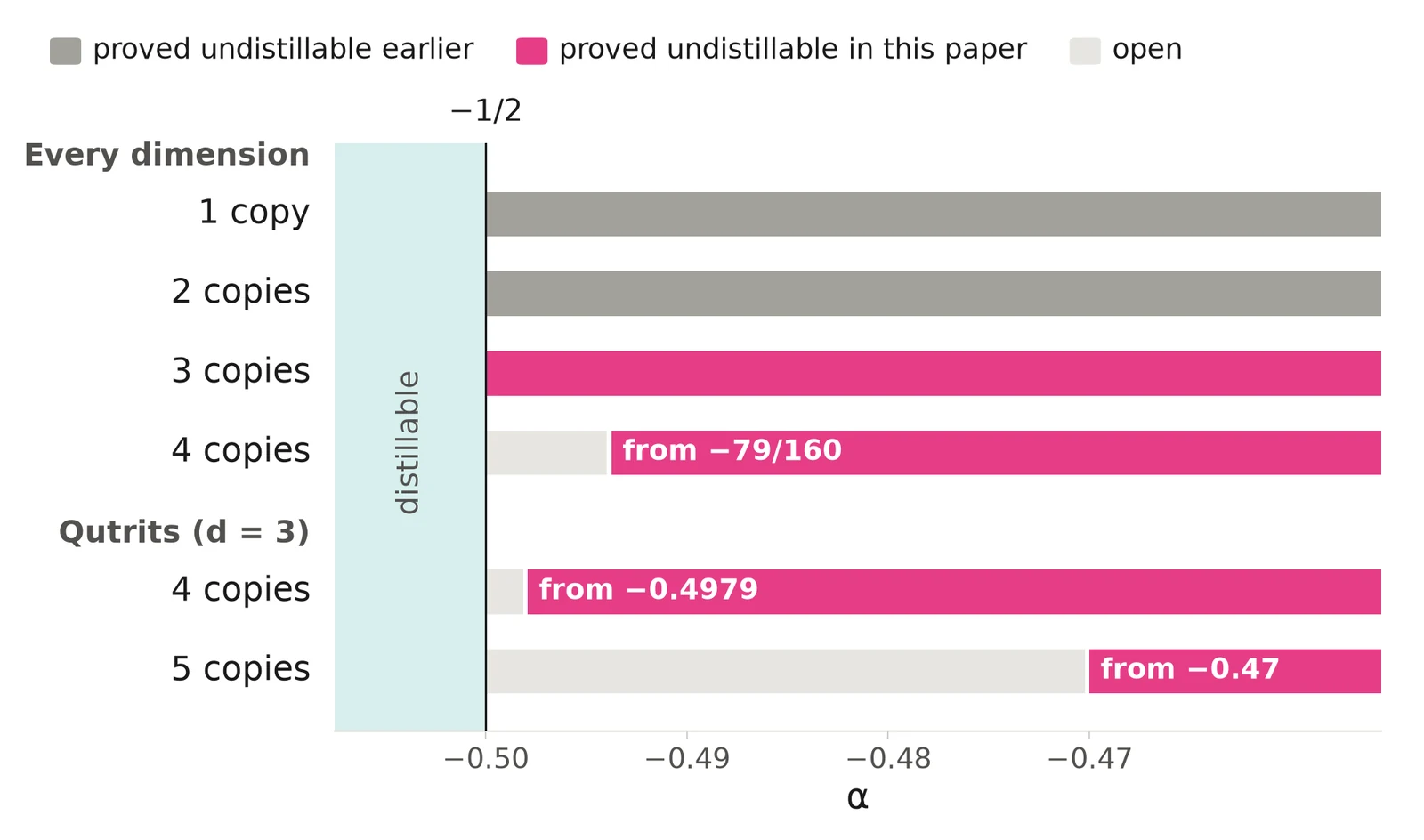
A Werner state is three-copy distillable exactly when it is one-copy distillable. For every local dimension d ≥ 3, the Werner state ρ(d,α) = (I + αF)/(d² + αd) is three-copy distillable if and only if α < −1/2. The same threshold for two-copy distillability was proved in July 2026, and the qutrit case of the three-copy problem had been settled by an archived certificate. For four copies we prove undistillability for every α ≥ −79/160 in every dimension, and for every α ≥ −0.4979 when d = 3. Five copies of the qutrit state are undistillable for every α ≥ −0.47. The endpoint α = −1/2 remains open from four copies on, and numerically the four-copy relaxation is not exact there. By a criterion of P. Costa Rico, each statement is equivalent to an inequality for complex matrices of rank at most two. We prove these inequalities with quartic moment relaxations and exact rational certificates. For three copies there is one certificate for each dimension up to 16, and one certificate whose entries are polynomials in 1/d covers every dimension d ≥ 9. For four copies, one certificate covers every dimension from 1.25·10⁹ on, and zero padding passes the result to all smaller dimensions.