The PPT² conjecture through a qutrit: barriers at 1/5 and a smaller constant when the first factor acts on M₃
Abstract
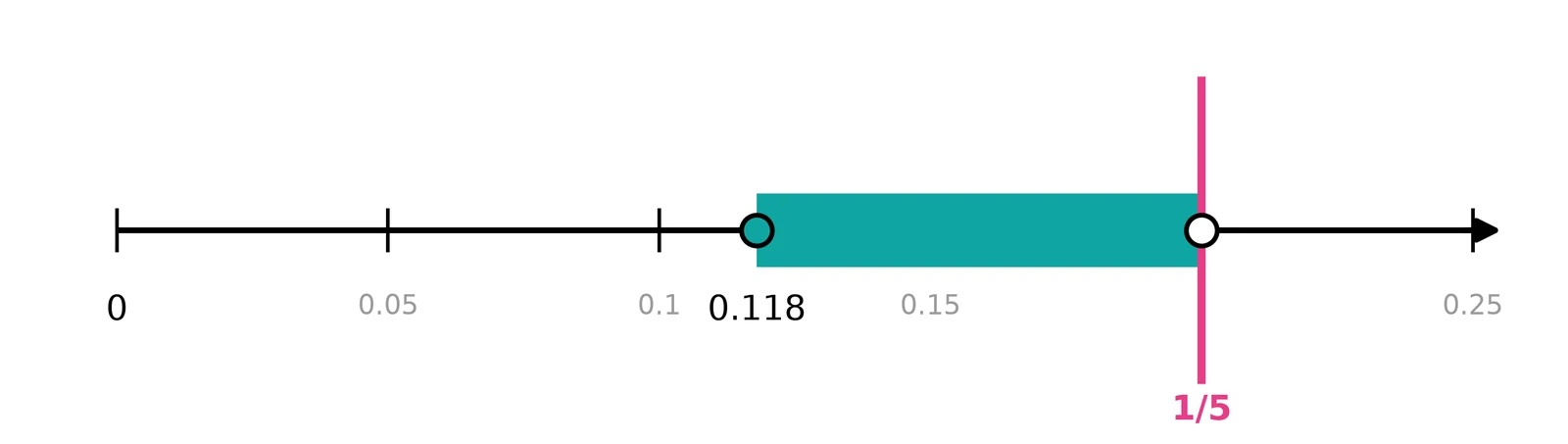
The PPT2 conjecture asserts that composites of PPT (completely positive and completely copositive) maps are entanglement breaking; it holds for composites through a qubit (the qubit theorem of K. Henry) and for maps on M3 (Christandl, Müller-Hermes and Wolf; Chen, Yang and Tang). For PPT maps Φ: Md1 → M3 and Ψ: M3 → Md2, averaging the qubit theorem over the qubit compressions of the middle qutrit shows, as in the companion paper for d1 = d2, that W + (1/5) Φ*(I)⊤ ⊗ Ψ(I) is separable, where W is the Choi matrix of Ψ ∘ Φ; the conjecture says that W itself is separable. Let Λ(3) be the least c for which ρ + c I ⊗ I is separable for the Choi matrix ρ of every PPT channel M3 → M3. We prove, without the qubit theorem, that 0.118 ≤ Λ(3) < 1/5, where the lower bound comes from an exact certificate whose arithmetic is checked in Lean 4. With the qubit theorem, 1/5 can then be replaced by Λ(3) whenever the first factor Φ acts on M3, that is, d1 = 3. Certificates built from the qubit theorem independently of Φ and Ψ cannot lower 1/5. For d1, d2 ≥ 3 with max(d1, d2) ≥ 4, neither can averages of certificates that act separately on the input, middle and output spaces, even if PPT2 through a qutrit were known in all smaller outer dimensions.
In plain words
Christandl’s PPT-squared conjecture predicts that applying two PPT quantum operations in turn leaves no entanglement, although each alone can leave a weak form of it. K. Henry proved the conjecture in 2026 for a two-level system between the operations. With three levels, averaging Henry’s result gives a weaker statement, with an added term whose constant is one fifth. This paper shows that such arguments cannot lower that constant unless tailored to at least one of the operations, and that Henry’s result gives a smaller constant when the first operation’s input also has three levels.
Formal statement and axioms
Each main result as stated in Lean, copied verbatim from the published package, with the axioms that the proof rests on. Lean v4.35.0-rc3, Mathlib c55e6e786f49. The package.
TwirlCert.TC4.Q.bound
Theorem 8.5, the last step of its certificate (c₀ ≤ λ): kernel-only
theorem bound (lam : ℝ) (h : 0 ≤ ((Z * rho).trace : ℝ) + lam * ((Z * R).trace : ℝ)) : (c0 : ℝ) ≤ lamDefinitions used in the statement
def Z : Matrix (Fin 3 × Fin 3) (Fin 3 × Fin 3) ℚ := qsc (m9 DQ.Z) DQ.sigdef rho : Matrix (Fin 3 × Fin 3) (Fin 3 × Fin 3) ℚ := qsc (m9 DQ.rho) DQ.sigRdef R : Matrix (Fin 3 × Fin 3) (Fin 3 × Fin 3) ℚ := trB rho ⊗ₖ (1 : Matrix (Fin 3) (Fin 3) ℚ)def c0 : ℚ := (DQ.c0N : ℚ) / (DQ.c0D : ℚ)def qsc {ι : Type*} (M : Matrix ι ι ℤ) (sig : ℕ) : Matrix ι ι ℚ := ((sig : ℚ))⁻¹ • M.map (Int.castRingHom ℚ)def m9 (L : List (List ℤ)) : Matrix (Fin 3 × Fin 3) (Fin 3 × Fin 3) ℤ :=
(rdM (3 * 3) L).submatrix finProdFinEquiv finProdFinEquivdef Z : List (List Int) :=
[[67904167, -67634975, -24532714, -28770190, -4344215, 9360226, -6761804, 102691548, 5532727],
[-67634975, 90735201, -32679504, 18048426, 21162094, 33334628, -47814234, 76004051, -16608926],
[-24532714, -32679504, 150671558, -31651376, -7541396, 4411918, -212504835, -26123842, -104993502],
[-28770190, 18048426, -31651376, 96202275, -46833579, -57023047, 140037932, -81406765, 75827899],
[-4344215, 21162094, -7541396, -46833579, 113196919, -45283837, 79240230, -64522346, 36943271],
[9360226, 33334628, 4411918, -57023047, -45283837, 93208527, -21115066, -142720831, -61231681],
[-6761804, -47814234, -212504835, 140037932, 79240230, -21115066, 225358129, 165200735, 149473667],
[102691548, 76004051, -26123842, -81406765, -64522346, -142720831, 165200735, 126628828, 117082254],
[5532727, -16608926, -104993502, 75827899, 36943271, -61231681, 149473667, 117082254, 109833148]]def sig : Nat := 1073741824def rho : List (List Int) :=
[[446110765615, 175312169418, 37110119934, 62927214859, 128848509726, -139897103604, -39505409064, -225490671303, -72045473816],
[175312169418, 318485623054, 66495937608, 90933911755, -224074316261, -82097218877, 29355061634, -118378149290, -8983200348],
[37110119934, 66495937608, 334918384835, -70431318968, -12882893479, 161147101401, 297202251258, 7117481974, 157883558354],
[62927214859, 90933911755, -70431318968, 378010986803, 59037249302, 147483222585, -212408012995, 188461283923, -131516061298],
[128848509726, -224074316261, -12882893479, 59037249302, 389477806673, 93561592458, -83606235447, 60206607653, -53066724504],
[-139897103604, -82097218877, 161147101401, 147483222585, 93561592458, 332025980028, 32673609151, 251175334780, 152201405343],
[-39505409064, 29355061634, 297202251258, -212408012995, -83606235447, 32673609151, 388870897458, -51925316484, 59706244941],
[-225490671303, -118378149290, 7117481974, 188461283923, 60206607653, 251175334780, -51925316484, 293152006716, -19422664608],
[-72045473816, -8983200348, 157883558354, -131516061298, -53066724504, 152201405343, 59706244941, -19422664608, 417491869331]]def sigR : Nat := 1099511627776def trB (M : Matrix (Fin 3 × Fin 3) (Fin 3 × Fin 3) ℚ) : Matrix (Fin 3) (Fin 3) ℚ :=
Matrix.of fun a b => ∑ p, M (a, p) (b, p)def c0N : Int := 59def c0D : Nat := 500def rdM (n : ℕ) (L : List (List ℤ)) : Matrix (Fin n) (Fin n) ℤ := Matrix.of fun i j => (L.getD i.val []).getD j.val 0Source: Zenodo record 23713731, ppt2-twirl-deposit-v5-lean.tar.gz/ppt2-twirl-deposit/lean/rows_a/RowsA/Twirl/TC4/MainQ.lean:L93-L93.
Axioms, as Lean reports them. Recorded in zenodo:23713731/ppt2-twirl-deposit-v5-lean.tar.gz/ppt2-twirl-deposit/lean/AXIOMS_ALL.txt:L3738 (the same line: zenodo:23713731/ppt2-twirl-deposit-v5-lean.tar.gz/ppt2-twirl-deposit/lean/rows_a/RowsA/Twirl/TC4/AXIOMS.txt:L63).
AXREPORT KERNEL TwirlCert.TC4.Q.bound : [propext, Classical.choice, Quot.sound]TwirlCert.TC4.Q.c0_eq
Theorem 8.5, the certificate’s constant c₀ = 59/500: kernel-only
theorem c0_eq : c0 = 59 / 500Definitions used in the statement
def c0 : ℚ := (DQ.c0N : ℚ) / (DQ.c0D : ℚ)def c0N : Int := 59def c0D : Nat := 500Source: Zenodo record 23713731, ppt2-twirl-deposit-v5-lean.tar.gz/ppt2-twirl-deposit/lean/rows_a/RowsA/Twirl/TC4/MainQ.lean:L53-L53.
Axioms, as Lean reports them. Recorded in zenodo:23713731/ppt2-twirl-deposit-v5-lean.tar.gz/ppt2-twirl-deposit/lean/AXIOMS_ALL.txt:L3739 (the same line: zenodo:23713731/ppt2-twirl-deposit-v5-lean.tar.gz/ppt2-twirl-deposit/lean/rows_a/RowsA/Twirl/TC4/AXIOMS.txt:L64).
AXREPORT KERNEL TwirlCert.TC4.Q.c0_eq : [propext, Classical.choice, Quot.sound]TwirlCert.TC4.T.bound
Remark 8.6, the last step of its certificate (1/20 ≤ λ_QD(ρ_T)): kernel-only
theorem bound (lam : ℝ) (h : 0 ≤ ((Z * rho).trace : ℝ) + lam * ((Z * R).trace : ℝ)) : (c0 : ℝ) ≤ lamDefinitions used in the statement
def Z : Matrix (Fin 3 × Fin 3) (Fin 3 × Fin 3) ℚ := qsc (m9 DT.Z) DT.sigdef rho : Matrix (Fin 3 × Fin 3) (Fin 3 × Fin 3) ℚ := TC3.rhoH Hdef R : Matrix (Fin 3 × Fin 3) (Fin 3 × Fin 3) ℚ := trB rho ⊗ₖ (1 : Matrix (Fin 3) (Fin 3) ℚ)def c0 : ℚ := (DT.c0N : ℚ) / (DT.c0D : ℚ)def qsc {ι : Type*} (M : Matrix ι ι ℤ) (sig : ℕ) : Matrix ι ι ℚ := ((sig : ℚ))⁻¹ • M.map (Int.castRingHom ℚ)def m9 (L : List (List ℤ)) : Matrix (Fin 3 × Fin 3) (Fin 3 × Fin 3) ℤ :=
(rdM (3 * 3) L).submatrix finProdFinEquiv finProdFinEquivdef Z : List (List Int) :=
[[187702165, -125488926, 102619183, -20212868, 36436308, -10497194, 117163985, -16903008, 136042238],
[-125488926, 142702108, 1969812, 36428344, 23911644, 32305370, -16846117, 12843042, -16903008],
[102619183, 1969812, 195903834, -10437550, 32319833, -123374326, 135930240, -16846117, 117163985],
[-20212868, 36428344, -10437550, 127998131, 20326598, -7329796, -123374326, 32305370, -10497194],
[36436308, 23911644, 32319833, 20326598, 12904473, 20326598, 32319833, 23911644, 36436308],
[-10497194, 32305370, -123374326, -7329796, 20326598, 127998131, -10437550, 36428344, -20212868],
[117163985, -16846117, 135930240, -123374326, 32319833, -10437550, 195903834, 1969812, 102619183],
[-16903008, 12843042, -16846117, 32305370, 23911644, 36428344, 1969812, 142702108, -125488926],
[136042238, -16903008, 117163985, -10497194, 36436308, -20212868, 102619183, -125488926, 187702165]]def sig : Nat := 1073741824def rhoH (H : Matrix (Fin 3) (Fin 3) ℤ) : Matrix (Fin 3 × Fin 3) (Fin 3 × Fin 3) ℚ :=
((1 : Matrix (Fin 3) (Fin 3) ℚ) ⊗ₖ H.map (Int.castRingHom ℚ)) * rhoT *
((1 : Matrix (Fin 3) (Fin 3) ℚ) ⊗ₖ H.map (Int.castRingHom ℚ))ᵀdef H : Matrix (Fin 3) (Fin 3) ℤ := TC3.Hz DT.Hdef trB (M : Matrix (Fin 3 × Fin 3) (Fin 3 × Fin 3) ℚ) : Matrix (Fin 3) (Fin 3) ℚ :=
Matrix.of fun a b => ∑ p, M (a, p) (b, p)def c0N : Int := 1def c0D : Nat := 20def rdM (n : ℕ) (L : List (List ℤ)) : Matrix (Fin n) (Fin n) ℤ := Matrix.of fun i j => (L.getD i.val []).getD j.val 0def rhoT : Matrix (Fin 3 × Fin 3) (Fin 3 × Fin 3) ℚ := (1 / 4 : ℚ) • (1 - P)def Hz (L : List (List ℤ)) : Matrix (Fin 3) (Fin 3) ℤ := Matrix.of fun i j => (L.getD i.val []).getD j.val 0def H : List (List Int) := [[1, 0, 0], [0, 1, 0], [0, 0, 1]]def P : Matrix (Fin 3 × Fin 3) (Fin 3 × Fin 3) ℚ := ∑ k, (tv k ⬝ᵥ tv k)⁻¹ • vecMulVec (tv k) (tv k)def tv (k : Fin 5) : Fin 3 × Fin 3 → ℚ := fun x => ta k x.1 * tb k x.2def ta : Fin 5 → Fin 3 → ℚ := ![![1, 0, 0], ![1, -1, 0], ![0, 0, 1], ![0, 1, -1], ![1, 1, 1]]def tb : Fin 5 → Fin 3 → ℚ := ![![1, -1, 0], ![0, 0, 1], ![0, 1, -1], ![1, 0, 0], ![1, 1, 1]]Source: Zenodo record 23713731, ppt2-twirl-deposit-v5-lean.tar.gz/ppt2-twirl-deposit/lean/rows_a/RowsA/Twirl/TC4/MainT.lean:L104-L104.
Axioms, as Lean reports them. Recorded in zenodo:23713731/ppt2-twirl-deposit-v5-lean.tar.gz/ppt2-twirl-deposit/lean/AXIOMS_ALL.txt:L3765 (the same line: zenodo:23713731/ppt2-twirl-deposit-v5-lean.tar.gz/ppt2-twirl-deposit/lean/rows_a/RowsA/Twirl/TC4/AXIOMS.txt:L90).
AXREPORT KERNEL TwirlCert.TC4.T.bound : [propext, Classical.choice, Quot.sound]5 more formal statements
TwirlCert.TC3.CH5.lam_lt
Remark 8.3 at ρ = ρ_H, λ < 1/5: kernel-only
theorem lam_lt : lam < 1 / 5Definitions used in the statement
def lam : ℚ := (DH5.lamN : ℚ) / (DH5.lamD : ℚ)def lamN : Int := 1def lamD : Nat := 10Source: Zenodo record 23713731, ppt2-twirl-deposit-v5-lean.tar.gz/ppt2-twirl-deposit/lean/rows_a/RowsA/Twirl/TC3/MainH5.lean:L123-L123.
Axioms, as Lean reports them. Recorded in zenodo:23713731/ppt2-twirl-deposit-v5-lean.tar.gz/ppt2-twirl-deposit/lean/AXIOMS_ALL.txt:L3613 (the same line: zenodo:23713731/ppt2-twirl-deposit-v5-lean.tar.gz/ppt2-twirl-deposit/lean/rows_a/RowsA/Twirl/TC3/AXIOMS.txt:L28).
AXREPORT KERNEL TwirlCert.TC3.CH5.lam_lt : [propext, Classical.choice, Quot.sound]TwirlCert.T25.K.corollary
Theorem 6.1(b), the decomposition in its proof: kernel-only
theorem corollary : WQ - (1 / 20 : ℂ) • MQ = ∑ k, choi (PsiQ ∘ₗ B k ∘ₗ A k ∘ₗ PhiQ)Definitions used in the statement
noncomputable def WQ : Matrix (Fin 4 × Fin 4) (Fin 4 × Fin 4) ℂ := choi (PsiQ ∘ₗ PhiQ)noncomputable def MQ : Matrix (Fin 4 × Fin 4) (Fin 4 × Fin 4) ℂ := choi (PsiQ ∘ₗ trMap (Fin 3) (Fin 3) ∘ₗ PhiQ)def choi [Fintype m] [DecidableEq m] (Φ : LinMap m n) : Matrix (m × n) (m × n) ℂ :=
∑ i : m, ∑ j : m, Matrix.single i j (1 : ℂ) ⊗ₖ Φ (Matrix.single i j 1)noncomputable def PsiQ : LinMap (Fin 3) (Fin 4) := ofChoi (((sPsi : ℂ)⁻¹) • ZPsi.map GaussianInt.toComplex)noncomputable def B (k : Fin 12) : LinMap (Fin 2) (Fin 3) := ofChoi (((sB : ℂ)⁻¹) • (ZB k).map GaussianInt.toComplex)noncomputable def A (k : Fin 12) : LinMap (Fin 3) (Fin 2) := ofChoi (((sA : ℂ)⁻¹) • (ZA k).map GaussianInt.toComplex)noncomputable def PhiQ : LinMap (Fin 4) (Fin 3) := ofChoi (((sPhi : ℂ)⁻¹) • ZPhi.map GaussianInt.toComplex)def trMap (m n : Type*) [Fintype m] [DecidableEq n] : LinMap m n where
toFun X := Matrix.trace X • (1 : Matrix n n ℂ)
map_add' X Y := by rw [Matrix.trace_add, add_smul]
map_smul' c X := by rw [Matrix.trace_smul, smul_eq_mul, mul_smul, RingHom.id_apply]abbrev LinMap (m n : Type*) := Matrix m m ℂ →ₗ[ℂ] Matrix n n ℂdef ofChoi (J : Matrix (m × n) (m × n) ℂ) : LinMap m n where
toFun X := ∑ a, ∑ b, X a b • blk J a b
map_add' X Y := by
simp only [Matrix.add_apply, add_smul, Finset.sum_add_distrib]
map_smul' c X := by
simp only [Matrix.smul_apply, smul_eq_mul, mul_smul, Finset.smul_sum, RingHom.id_apply]def sPsi : ℕ := KData.JPsiQ.sdef ZPsi : Matrix (Fin 3 × Fin 4) (Fin 3 × Fin 4) GaussianInt := zmatP 3 4 KData.JPsiQ.Zdef sB : ℕ := KData.JB00.sdef ZB (k : Fin 12) : Matrix (Fin 2 × Fin 3) (Fin 2 × Fin 3) GaussianInt := zmatP 2 3 (ZBdata k)def sA : ℕ := KData.JA00.sdef ZA (k : Fin 12) : Matrix (Fin 3 × Fin 2) (Fin 3 × Fin 2) GaussianInt := zmatP 3 2 (ZAdata k)def sPhi : ℕ := KData.JPhiQ.sdef ZPhi : Matrix (Fin 4 × Fin 3) (Fin 4 × Fin 3) GaussianInt := zmatP 4 3 KData.JPhiQ.Zdef blk {R : Type*} (M : Matrix (m × n) (m × n) R) (a b : m) : Matrix n n R :=
Matrix.of fun i j => M (a, i) (b, j)def s : Nat := 17592186044416def zmatP (a b : ℕ) (L : List (List (ℤ × ℤ))) : Matrix (Fin a × Fin b) (Fin a × Fin b) GaussianInt :=
Matrix.of fun x y => gOf ((L.getD (b * x.1.val + x.2.val) []).getD (b * y.1.val + y.2.val) (0, 0))def s : Nat := 4294967296def ZBdata : Fin 12 → List (List (ℤ × ℤ)) :=
![KData.JB00.Z, KData.JB01.Z, KData.JB02.Z, KData.JB03.Z, KData.JB04.Z, KData.JB05.Z, KData.JB06.Z, KData.JB07.Z,
KData.JB08.Z, KData.JB09.Z, KData.JB10.Z, KData.JB11.Z]def s : Nat := 21980765568842235092570437163428278140380707147765923759977896649039336984254360038017279550799181804487869903927369660206719397902159693722256697264218654409344018893569532657160456888084124796876667343707651663499776444381840623429299105477850190091449550783698646263209721187397299789304373316449351105122315788603031845325518882055440223648486676190661516984320def ZAdata : Fin 12 → List (List (ℤ × ℤ)) :=
![KData.JA00.Z, KData.JA01.Z, KData.JA02.Z, KData.JA03.Z, KData.JA04.Z, KData.JA05.Z, KData.JA06.Z, KData.JA07.Z,
KData.JA08.Z, KData.JA09.Z, KData.JA10.Z, KData.JA11.Z]def s : Nat := 17592186044416def gOf (t : ℤ × ℤ) : GaussianInt := ⟨t.1, t.2⟩Source: Zenodo record 23713731, ppt2-twirl-deposit-v5-lean.tar.gz/ppt2-twirl-deposit/lean/rows_a/RowsA/Twirl/T25/KFacts.lean:L147-L147.
Axioms, as Lean reports them. Recorded in zenodo:23713731/ppt2-twirl-deposit-v5-lean.tar.gz/ppt2-twirl-deposit/lean/AXIOMS_ALL.txt:L3314 (the same line: zenodo:23713731/ppt2-twirl-deposit-v5-lean.tar.gz/ppt2-twirl-deposit/lean/rows_a/RowsA/Twirl/T25/AXIOMS_K.txt:L37).
AXREPORT KERNEL TwirlCert.T25.K.corollary : [propext, Classical.choice, Quot.sound]TwirlCert.T26.K.sum_maps
Theorem 6.2, the identity in its proof: kernel-only
theorem sum_maps : ∑ k, adMap (iota k) ∘ₗ A k = idMap (Fin 3) + (1 / 10 : ℂ) • trMap (Fin 3) (Fin 3)Definitions used in the statement
def adMap {m k : Type*} [Fintype k] (ι : Matrix m k ℂ) : LinMap k m where
  toFun X := ι * X * ιᴴ
  map_add' X Y := by rw [Matrix.mul_add, Matrix.add_mul]
  map_smul' c X := by rw [Matrix.mul_smul, Matrix.smul_mul, RingHom.id_apply]
noncomputable def iota (k : Fin 16) : Matrix (Fin 3) (Fin 2) ℂ := ((sI : ℂ)⁻¹) • (ZI k).map GaussianInt.toComplexnoncomputable def A (k : Fin 16) : LinMap (Fin 3) (Fin 2) := ofChoi (((sA : ℂ)⁻¹) • (ZA k).map GaussianInt.toComplex)abbrev LinMap (m n : Type*) := Matrix m m ℂ →ₗ[ℂ] Matrix n n ℂabbrev idMap (m : Type*) : LinMap m m := LinearMap.iddef trMap (m n : Type*) [Fintype m] [DecidableEq n] : LinMap m n where
toFun X := Matrix.trace X • (1 : Matrix n n ℂ)
map_add' X Y := by rw [Matrix.trace_add, add_smul]
map_smul' c X := by rw [Matrix.trace_smul, smul_eq_mul, mul_smul, RingHom.id_apply]def sI : ℕ := KData.IOTA00.sdef ZI (k : Fin 16) : Matrix (Fin 3) (Fin 2) GaussianInt := zmatR 3 2 (ZIdata k)def ofChoi (J : Matrix (m × n) (m × n) ℂ) : LinMap m n where
toFun X := ∑ a, ∑ b, X a b • blk J a b
map_add' X Y := by
simp only [Matrix.add_apply, add_smul, Finset.sum_add_distrib]
map_smul' c X := by
simp only [Matrix.smul_apply, smul_eq_mul, mul_smul, Finset.smul_sum, RingHom.id_apply]def sA : ℕ := KData.JA00.sdef ZA (k : Fin 16) : Matrix (Fin 3 × Fin 2) (Fin 3 × Fin 2) GaussianInt := zmatP 3 2 (ZAdata k)def s : Nat := 573573585631829155422631237427594284433507329808862702992768617465573186288457486550def zmatR (m n : ℕ) (L : List (List (ℤ × ℤ))) : Matrix (Fin m) (Fin n) GaussianInt :=
Matrix.of fun i j => gOf ((L.getD i.val []).getD j.val (0, 0))def ZIdata : Fin 16 → List (List (ℤ × ℤ)) :=
![KData.IOTA00.Z, KData.IOTA01.Z, KData.IOTA02.Z, KData.IOTA03.Z, KData.IOTA04.Z, KData.IOTA05.Z, KData.IOTA06.Z,
KData.IOTA07.Z, KData.IOTA08.Z, KData.IOTA09.Z, KData.IOTA10.Z, KData.IOTA11.Z, KData.IOTA12.Z, KData.IOTA13.Z,
KData.IOTA14.Z, KData.IOTA15.Z]def blk {R : Type*} (M : Matrix (m × n) (m × n) R) (a b : m) : Matrix n n R :=
Matrix.of fun i j => M (a, i) (b, j)def s : Nat := 18434694020866064386557432932037736125426943188472470193932323576888241617466498910349520505364634476803384349901331641426837469015964423958346733044744020519547260023872001382593319365496922125025736114469327028436890593198596211540257154974818528801221651042308425297384109458007060946710603797143095560945459475154322932386835750234770289879417160983470015808658578023478657952135611048083330972148457163393506543107478848068921182324689721622909227023235096575541015109743830208312290999983289640228476582996616818105061369613556475904065746357763948238215061111874008830688393002990236566557077208103232238458506776685223476259779380009584167525819558058244920727184863360534076961786618130654200348395788086483142948631347200def zmatP (a b : ℕ) (L : List (List (ℤ × ℤ))) : Matrix (Fin a × Fin b) (Fin a × Fin b) GaussianInt :=
Matrix.of fun x y => gOf ((L.getD (b * x.1.val + x.2.val) []).getD (b * y.1.val + y.2.val) (0, 0))def ZAdata : Fin 16 → List (List (ℤ × ℤ)) :=
![KData.JA00.Z, KData.JA01.Z, KData.JA02.Z, KData.JA03.Z, KData.JA04.Z, KData.JA05.Z, KData.JA06.Z, KData.JA07.Z,
KData.JA08.Z, KData.JA09.Z, KData.JA10.Z, KData.JA11.Z, KData.JA12.Z, KData.JA13.Z, KData.JA14.Z, KData.JA15.Z]def gOf (t : ℤ × ℤ) : GaussianInt := ⟨t.1, t.2⟩Source: Zenodo record 23713731, ppt2-twirl-deposit-v5-lean.tar.gz/ppt2-twirl-deposit/lean/rows_a/RowsA/Twirl/T26/KFacts.lean:L92-L92.
Axioms, as Lean reports them. Recorded in zenodo:23713731/ppt2-twirl-deposit-v5-lean.tar.gz/ppt2-twirl-deposit/lean/AXIOMS_ALL.txt:L3455 (the same line: zenodo:23713731/ppt2-twirl-deposit-v5-lean.tar.gz/ppt2-twirl-deposit/lean/rows_a/RowsA/Twirl/T26/AXIOMS_K.txt:L70).
AXREPORT KERNEL TwirlCert.T26.K.sum_maps : [propext, Classical.choice, Quot.sound]TwirlCert.T27.K.prop_10_6_facts
Proposition 3.6, the exact facts †3: kernel-only
theorem prop_10_6_facts :
    Xᵀ = X ∧ X.trace = 1 ∧ (∀ a i j : Fin 3, X (a, i) (a, j) = if i = j then 1 / 9 else 0) ∧
    (X.map (Rat.castHom ℂ)).PosDef ∧ ((ptA X).map (Rat.castHom ℂ)).PosDef ∧
    ((1 - Oᵀ * O).map (Rat.castHom ℂ)).PosDef ∧
    (Oᵀ * realign X).trace = 3109624483 / 3000000000 ∧ 1 < (Oᵀ * realign X).trace
Definitions used in the statement
abbrev Idx := Fin 3 × Fin 3def X : Matrix Idx Idx ℚ := Matrix.of fun x y => (XZ x y : ℚ) / KData.sXdef ptA {R : Type*} (M : Matrix (m × n) (m × n) R) : Matrix (m × n) (m × n) R :=
Matrix.of fun x y => M (y.1, x.2) (x.1, y.2)def O : Matrix Idx Idx ℚ := Matrix.of fun x y => (OZ x y : ℚ) / KData.sOdef realign {α : Type*} {m n : Type*} (M : Matrix (m × n) (m × n) α) : Matrix (m × m) (n × n) α :=
Matrix.of fun r c => M (r.1, c.1) (r.2, c.2)def XZ : Matrix Idx Idx ℤ := zm KData.XZdef sX : Nat := 90000def OZ : Matrix Idx Idx ℤ := zm KData.OZdef sO : Nat := 1000000def zm (L : List (List ℤ)) : Matrix Idx Idx ℤ :=
Matrix.of fun x y => (L.getD (3 * x.1.val + x.2.val) []).getD (3 * y.1.val + y.2.val) 0Source: Zenodo record 23713731, ppt2-twirl-deposit-v5-lean.tar.gz/ppt2-twirl-deposit/lean/rows_a/RowsA/Twirl/T27/KMain.lean:L144-L148.
Axioms, as Lean reports them. Recorded in zenodo:23713731/ppt2-twirl-deposit-v5-lean.tar.gz/ppt2-twirl-deposit/lean/AXIOMS_ALL.txt:L3542 (the same line: zenodo:23713731/ppt2-twirl-deposit-v5-lean.tar.gz/ppt2-twirl-deposit/lean/rows_a/RowsA/Twirl/T27/AXIOMS_K.txt:L27).
AXREPORT KERNEL TwirlCert.T27.K.prop_10_6_facts : [propext, Classical.choice, Quot.sound]TwirlCert.TC3.birank
Proposition C.2, its arithmetic step: kernel-only
theorem birank (r s : ℕ) :
    (4 ≤ r ∧ 4 ≤ s ∧ r ^ 2 + s ^ 2 ≤ 82 ∧ (r = 4 ↔ s = 4)) ↔ (r, s) ∈ birankList
Definitions used in the statement
def birankList : List (ℕ × ℕ) := [(4, 4), (5, 5), (5, 6), (6, 5), (5, 7), (7, 5), (6, 6)]Source: Zenodo record 23713731, ppt2-twirl-deposit-v5-lean.tar.gz/ppt2-twirl-deposit/lean/rows_a/RowsA/Twirl/TC3/Birank.lean:L21-L22.
Axioms, as Lean reports them. Recorded in zenodo:23713731/ppt2-twirl-deposit-v5-lean.tar.gz/ppt2-twirl-deposit/lean/AXIOMS_ALL.txt:L3660 (the same line: zenodo:23713731/ppt2-twirl-deposit-v5-lean.tar.gz/ppt2-twirl-deposit/lean/rows_a/RowsA/Twirl/TC3/AXIOMS.txt:L75).
AXREPORT KERNEL TwirlCert.TC3.birank : [propext, Classical.choice, Quot.sound]