On the minimal dimension of range-criterion counterexamples to the PPT² conjecture
In plain words
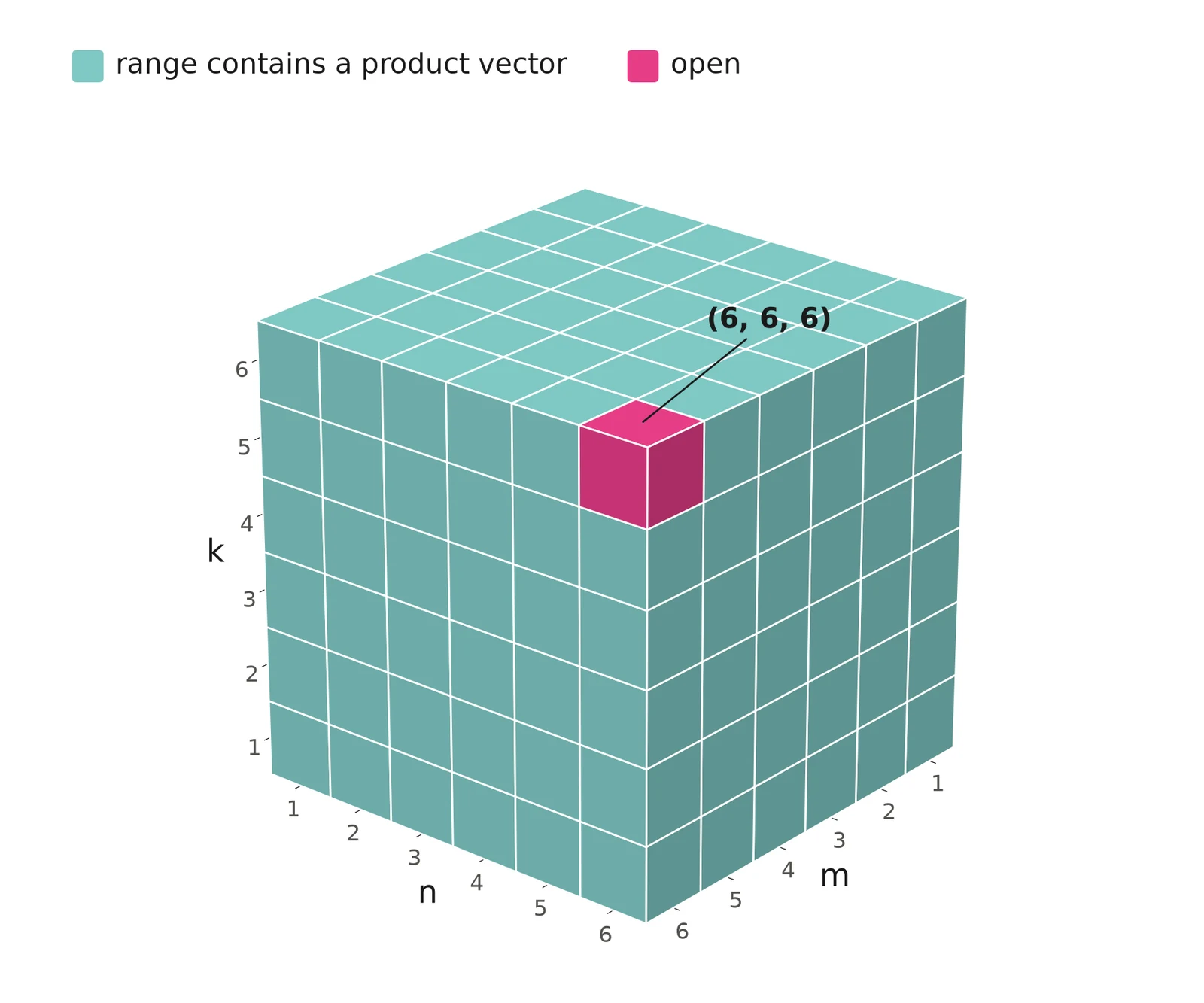
The range criterion is a standard test that can prove a quantum state is entangled. Christandl's PPT-squared conjecture predicts that entanglement never survives two successive quantum operations of a certain kind. A counterexample announced in 2026 uses ten-dimensional systems and is certified by the range criterion. The paper proves that the test cannot certify a counterexample when every system has at most five dimensions. For systems of up to six dimensions, only one case remains open: whether the test can certify a counterexample when the input, intermediate and output systems are all six-dimensional. The paper's main result does not rule out counterexamples that the test cannot certify.
Abstract
The PPT² conjecture asserts that the composition of two completely positive and completely copositive (PPT) maps is entanglement breaking. A recently announced counterexample, with PPT maps M₁₀ → M₆ → M₁₀, is certified by the range criterion: the range of the composite Choi matrix contains no nonzero product vector. We ask how small a counterexample certified in this way can be. For PPT maps Φ: Mₘ → Mₖ and Ψ: Mₖ → Mₙ with Ψ ∘ Φ ≠ 0 and max(m, k, n) ≤ 6 we prove that the range of the Choi matrix of Ψ ∘ Φ contains a nonzero product vector whenever k ≤ 5 or min(m, n) ≤ 5. Hence the range criterion cannot certify a counterexample on M₄ or M₅, and among the types with all three dimensions at most six only (6, 6, 6) remains open. Since the range is spanned by products of Kraus operators, the question is when such a span can avoid the matrices of rank one. The computer-assisted proof combines rank bounds for PPT maps with Chern class and excess intersection computations; its computed facts are checked in Lean 4, modulo classical, quoted or hand-proved inputs. The announced counterexample lifts through exterior powers a map on M₄ built from a pencil of real matrices (a map of pencil type). When the map of pencil type loses rank transversally at finitely many points, its lifts through any Schur functor, exterior powers included, put product vectors into the kernel of the composite Choi matrix. When the composite is also nonzero, these product vectors form an unextendible product set only for exterior powers, and then one of the three dimensions is at least ten.