Engineers draw on four-dimensional packings of equal balls to design power-efficient signals for optical links. Each ball's region is the set of points nearer to it than to any other ball. The 24-cell conjecture says that no region is smaller than a regular 24-cell, the shape of every region in the densest packing known. That would make this packing the densest possible. A proof of the full conjecture was announced in 2026. This paper gives a separate proof of the case in which, for a given ball, each of the others either touches it or keeps well clear of it.
Abstract
The 24-cell conjecture states that every Voronoi cell of a packing of unit balls in R4 has volume at least 8, the volume of the regular 24-cell. We prove it for every cell whose ball touches all balls centred within distance 2√2 of its centre, with equality only for the D4 root configuration. The proof bounds the cell from below by a third-order inclusion–exclusion expansion truncated at radius √2, which is exact at D4. Configurations with 24 contacts are D4 by the uniqueness theorem of de Laat, Leijenhorst and de Muinck Keizer. For at most 23 contacts we give an exact rational certificate for the second level of the Lasserre hierarchy with value 8.03874..., together with interval-arithmetic bounds for the polynomial approximations it uses. We also show that, for every packing, no point inside the ball of radius √2 lies in five of the caps cut off by the Voronoi hyperplanes, so the inclusion–exclusion expansion of the truncated cell stops at order four.
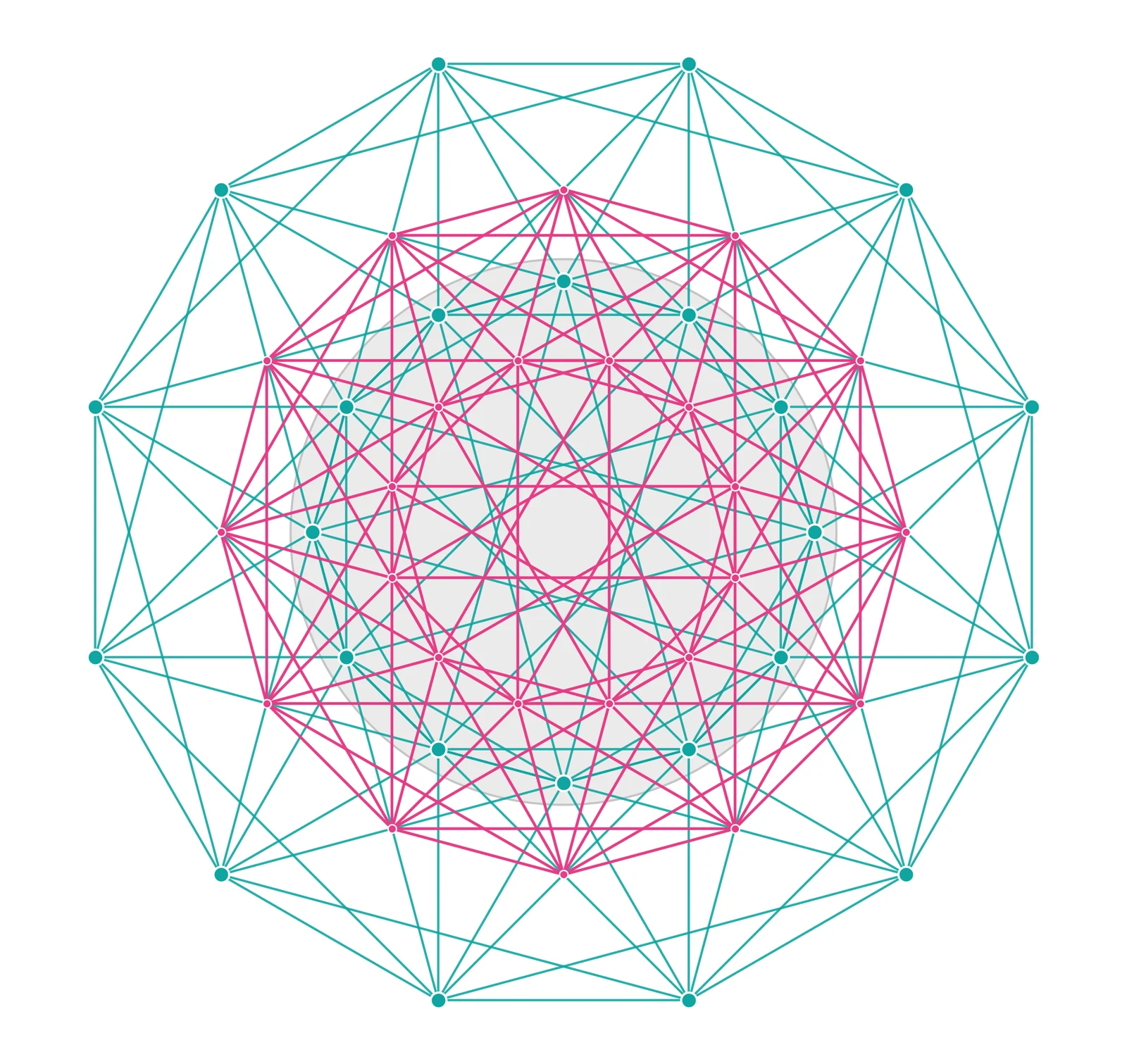
Illustration of the case of equality in the paper’s bound, as it occurs in D₄, the densest packing known in four dimensions. The picture is a projection onto a plane in which the configuration has 12-fold symmetry. The grey disc is a ball of the packing, and the teal dots are the centres of the 24 balls that touch it. Teal segments join the 96 pairs of these centres whose balls touch each other. The magenta lines are the edges of the grey ball’s Voronoi cell, a regular 24-cell of volume 8 with one facet halfway to each touching neighbour. The paper proves that in any packing of unit balls in four dimensions, if a ball touches all the other balls whose centres lie at distance less than 2√2 from its own, then its Voronoi cell has volume at least 8, with equality only when the touching balls are arranged as shown here.