A lower bound for the smallest limit point of the absolute Mahler measure of totally positive algebraic integers
In plain words
An algebraic integer is totally positive if all its conjugates are positive. Schinzel showed in 1973 that its absolute Mahler measure, a measure of size computed from its polynomial, is then at least the golden ratio unless the number is 1. Smyth's work from 1980 shows that every value from 1.7274 upward is a limit of these measures, and Flammang proved in 2015 that all but finitely many totally positive algebraic integers have measure at least 1.722069. Here the bound rises to 1.7234615, for all but finitely many totally positive algebraic numbers, integers or not.
Abstract
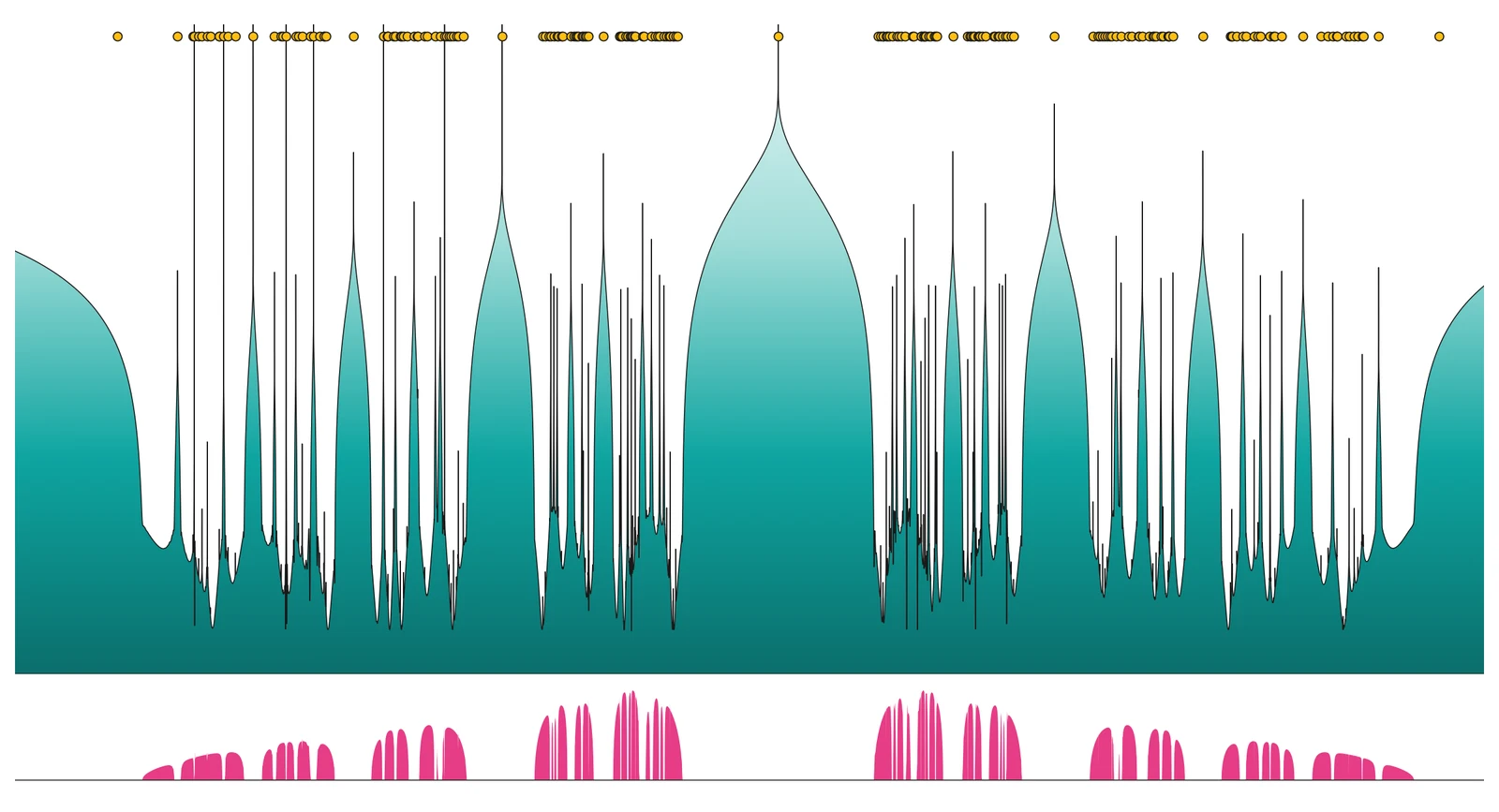
Let Ω(α) = M(α)1/deg α be the absolute Mahler measure of an algebraic number α, so that log Ω(α) is its absolute logarithmic Weil height. By work of Smyth, every number in [1.7273…, ∞) is a limit point of the values of Ω on totally positive algebraic integers, and Flammang proved that Ω(α) ≥ 1.722069 for every totally positive algebraic integer α outside an explicit finite set. We prove that all but finitely many totally positive algebraic numbers α satisfy Ω(α) > 1.7234615. Hence the smallest limit point of these values lies between 1.7234615 and 1.7274, and all but finitely many totally real algebraic numbers β satisfy log Ω(β) > 0.2721673. The proof combines Smyth's method of auxiliary functions with the logarithmic energy term that Orloski, Talebizadeh Sardari and Smith derived from the integrality of discriminants. The auxiliary function uses x and eighteen of Flammang's polynomials, and the reference measure has a piecewise linear density on 5473 rational nodes, so that its potential and energy have closed forms. Two separately written programs verify the resulting inequality on the positive half-line in ball arithmetic.