An algebraic integer is totally positive if all roots of its polynomial, its conjugates, are positive. Its absolute Mahler measure is a measure of size computed from that polynomial. Smyth's work from 1980 shows that the smallest value at which the measures of such numbers accumulate is at most 1.7274. Using Smith's 2024 description of how conjugates can be spread out, this paper lowers the bound to 1.7239501 and shows that infinitely many totally positive algebraic integers have measure below that number. A companion paper shows that the smallest accumulation value is above 1.7234615.
Abstract
Let Ω(α) = M(α)1/deg α be the absolute Mahler measure of an algebraic number α, and let ℓ+ be the smallest limit point of the values of Ω on totally positive algebraic integers. Smyth's work gives ℓ+ ≤ ℓ2 = 1.72731…, where ℓ = 1.31427… is the limit point that he found for totally real algebraic integers. We prove ℓ+ ≤ 1.7239501, and that infinitely many totally positive algebraic integers satisfy Ω(α) < 1.7239501. Together with the lower bound ℓ+ > 1.7234615 of a companion paper, this places ℓ+ in an interval of length less than 4.9·10−4. The proof exhibits a measure μ on [0, 9] with a piecewise linear density on 3481 rational nodes, together with a lower bound for its logarithmic potential by a combination of log|Q| for 21 irreducible polynomials Q, namely x and polynomials taken from Flammang's work. By a criterion of Smith, μ, normalized to mass 1, is a limit of distributions of conjugates of totally positive algebraic integers, and its integral of log+ x gives the bound. Two separately written programs verify the conditions in ball arithmetic.
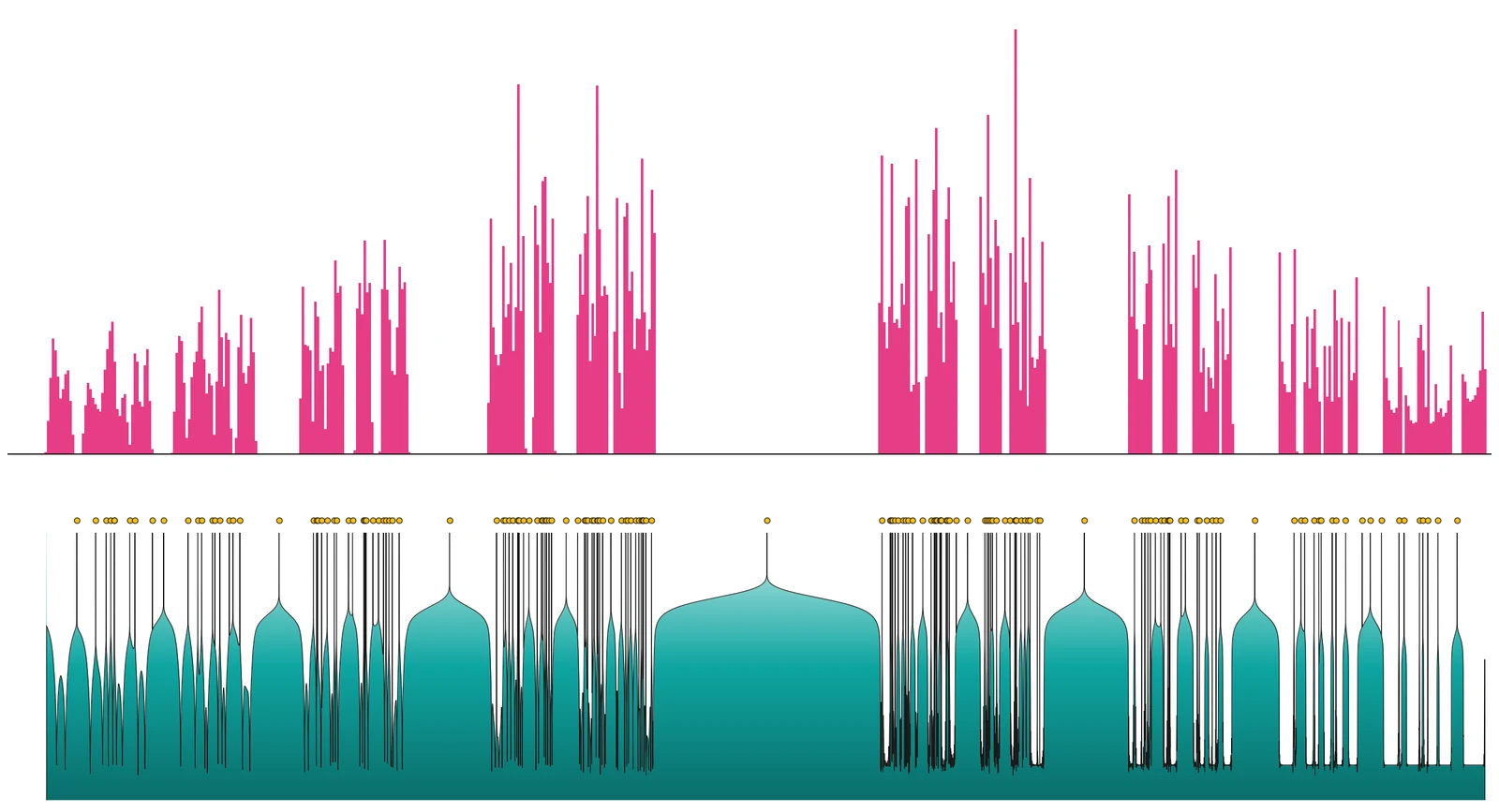
Illustration of the certificate, on a logarithmic axis from x = 0.1 to 9. Top: the measure μ of the proof, which has a piecewise linear density on 3481 nodes between 0.1125 and 8.8125 and vanishes on many gaps; each bar is the mass of μ in one of 600 equal intervals of log x, divided by the interval's length, so that area is mass. Bottom: log₁₀ h for the certificate's function h(x) = U(x) − Σⱼ bⱼ log|Qⱼ(x)|, where U(x) = ∫ log|x − y| dμ(y) is the potential of μ and Q₁, …, Q₂₁ are the polynomials of the certificate, x and polynomials from Flammang's work, with weights bⱼ; the panel runs from h = 10^(−6.5) at the bottom up to h = 10, where the curve is cut off. h rises to infinity at the 161 real roots of the Qⱼ between 0.1125 and 8.8125, marked by the yellow dots, and arches up over the gaps of μ; where μ carries mass, h dips close to 0, with a smallest value of about 1.6·10⁻⁶ on the plotted grid. The paper proves h ≥ 0 on [0.1125, 8.8125]. With two further conditions, a criterion of Smith then shows that μ, normalized to mass 1, is a limit of distributions of conjugates of totally positive algebraic integers, and the bound, e raised to the average over μ of log⁺ x = max(log x, 0), is 1.72395005…, rounded up to 1.7239501. The picture is computed in floating point from the certificate's exact data.