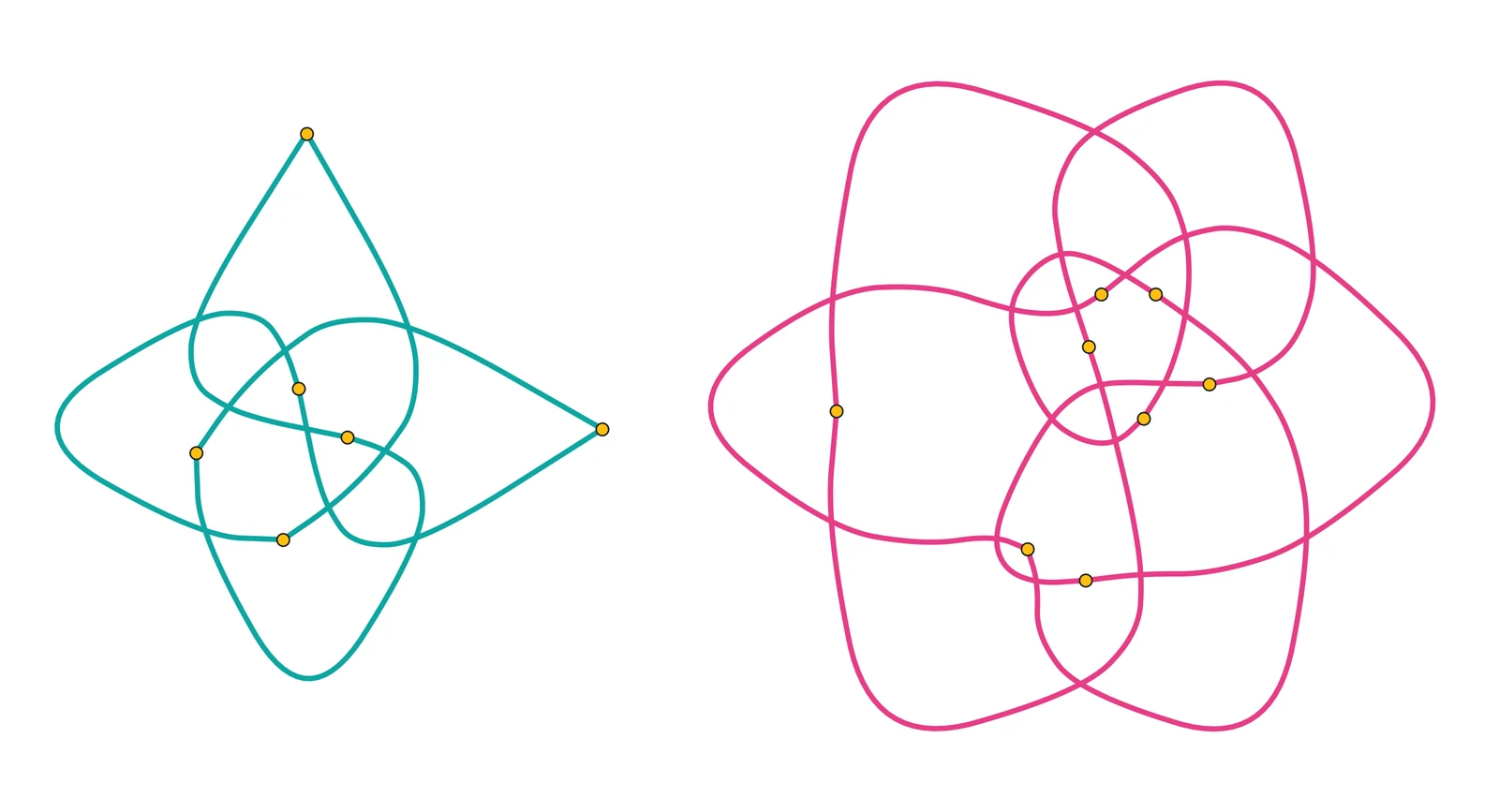
A thrackle on n vertices has fewer than 51n/38 edges
In plain words
A thrackle is a drawing of points joined by curves in which every two curves meet exactly once, at a shared endpoint or by crossing. Conway conjectured that a thrackle never has more curves than points. In 2026 Tóth and, separately, Scoppetto proved it has fewer than 18/13 times as many. This paper lowers the factor to 51/38. A computer search, repeated by a second program written independently, shows a ring of six curves and a ring of eight sharing one curve cannot be drawn this way; with further computer checks, Xu's counting argument gives the bound.
Abstract
A thrackle is a drawing of a graph in the plane in which every two edges meet exactly once, either at a common endpoint or at a proper crossing. Conway conjectured that a thrackle with n vertices has at most n edges. We prove that a thrackle with n ≥ 4 vertices has at most 51(n − 1)/38 edges, improving the bound 18(n − 1)/13 obtained by Tóth and, independently, by Scoppetto. The main new ingredient, suggested by Scoppetto, is that the dumbbell DB(6, 8, −1), a 6-cycle and an 8-cycle sharing one edge, is not thrackleable, which we show by a computer search. It follows, by an enumeration, that no 6-cycle of a triangle-free thrackleable graph shares an edge with an 8-cycle. With a second enumeration, which shows that a face of size 10 shares at most seven edges with faces of size 6, Xu's discharging argument then gives 51/38. The search tests the planarity of graphs that encode the orders of the crossings along the edges, following Fulek and Pach, and prunes with the lists of all such orders for subgraphs; for DB(6, 8, −1) it makes about 2.1·1011 planarity tests. We repeated the computations with a second implementation, written independently of the first.