The Steiner ratio is at least 0.8564
In plain words
On a flat map, the shortest road network that joins a set of towns may need extra junctions between them. Gilbert and Pollak conjectured in 1968 that junctions never save more than about 13.4 percent compared with the best network without them. That is the saving for three towns at the corners of an equilateral triangle. In 2026, Ke and colleagues gave a computer-assisted proof of a looser limit: junctions never save more than 14.41 percent. In this paper, two new geometric results let the same method lower the limit to 14.36 percent.
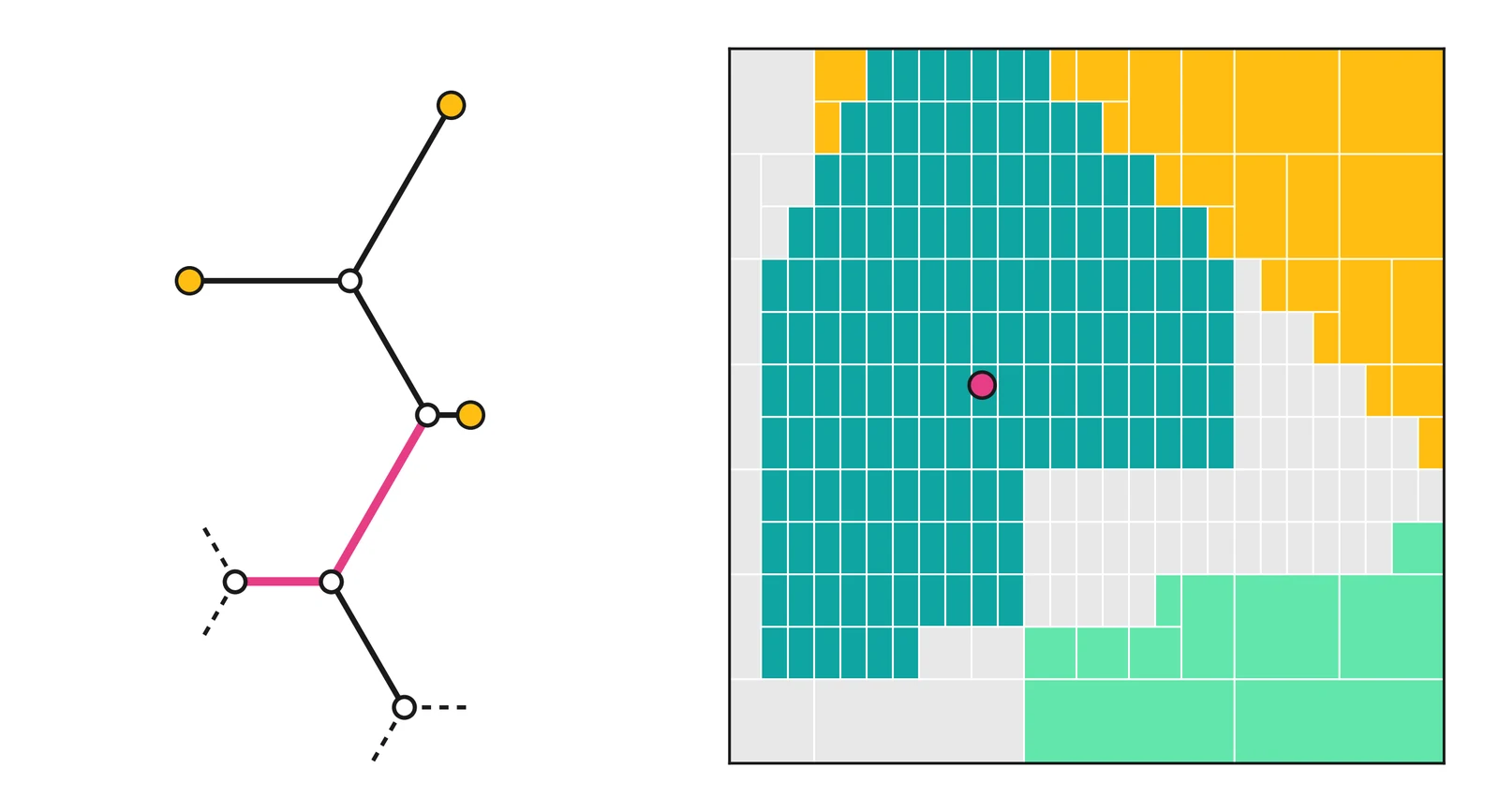
Abstract
The Steiner ratio is the infimum, over finite sets of points in the Euclidean plane, of the length of a Steiner minimal tree divided by the length of a minimum spanning tree. Gilbert and Pollak conjectured that it equals √3/2 = 0.8660…. We prove that it is at least 2141/2500 = 0.8564, improving the bound 0.8559 of Ke, Huang, Shu, He, Gai and Wang. Their method reduces the induction step of Du and Hwang to finitely many inequalities on boxes in the space of local configurations of a Steiner minimal tree. We use it with complete proofs of the geometric lemmas it needs, with two new lemmas that use the minimality of the tree among all networks, and with explicit networks for reconnections of four points. Our certificate consists of 555,102,905 boxes. A checker written independently of the program that generated them verifies, in ball arithmetic at the value 2141/2500, the inequality of every box that meets the domain of its family, and a second program verifies that the boxes of each family tile its parameter space. We also show that, near one configuration, every splitting of the form used by Ke et al., priced with their lemmas, has positive cost once the ratio is at least 0.856. A complete certificate of this form for any value of at least 0.856, such as the conditional value 0.860 listed in Tao’s repository of optimization constants, therefore needs lemmas beyond the published ones.