An upper bound of 2√2 for the three-dimensional sofa problem in a snake-shaped corridor
In plain words
In 1966 Moser asked for the largest sofa that can turn the corner of a hallway one unit wide; Hammersley showed its area is at most 2.83. O'Rourke asked the same in 2016 for a square corridor of that width turning sideways and then upwards, and Georgiev, Gómez-Serrano, Tao and Wagner listed it among their problems in 2025. Combining Tang's approach with Hammersley's argument, the paper proves the volume is again at most 2.83 when the turns are far enough apart. The proof can be checked by hand, unlike Tang's best previous bound, 3.4083.
Abstract
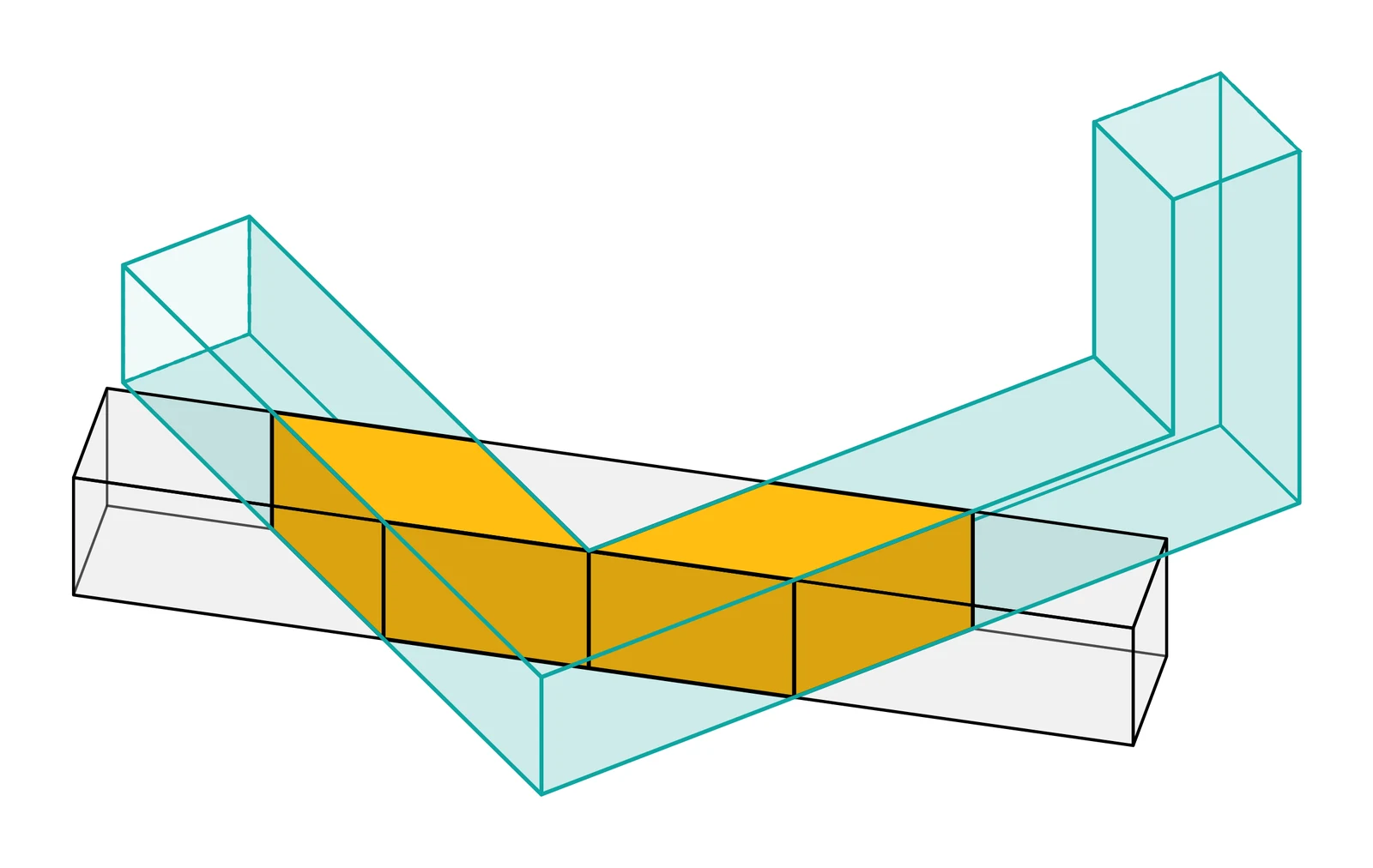
Georgiev, Gómez-Serrano, Tao and Wagner ask for the largest volume of a connected body that can be moved through a three-dimensional corridor of unit-square cross-section with two turns that are far apart, one in the x–y plane and one in the y–z plane (their Problem 6.64). Tang proved upper bounds for this problem, the best of which, 3.4083, rests on a branch-and-bound computation in double precision. We prove, without a computer, that the volume is at most 2√2 = 2.8284... whenever the straight section between the turns is longer than 2 + √2. The proof combines Tang's first-crossing argument with two observations. First, two tubes of unit-square cross-section whose axes make an angle θ meet in volume at most 1/sin θ, and this bound is sharp. Second, unless the volume is less than √2, the axis of the body's entry tube, the moving copy of the infinite tube that contains the entry arm, makes the angle π/4 with the middle arm at some time when the body still lies in the first two arms. This is the three-dimensional analogue of Hammersley's bound 2√2 for the planar moving sofa problem, and the information used at this single time cannot yield a better bound. For shorter straight sections the same argument gives explicit bounds that, together with the main bound, improve Tang's bounds on the largest volume for every length greater than √2 outside the interval (2.2, 2.26).