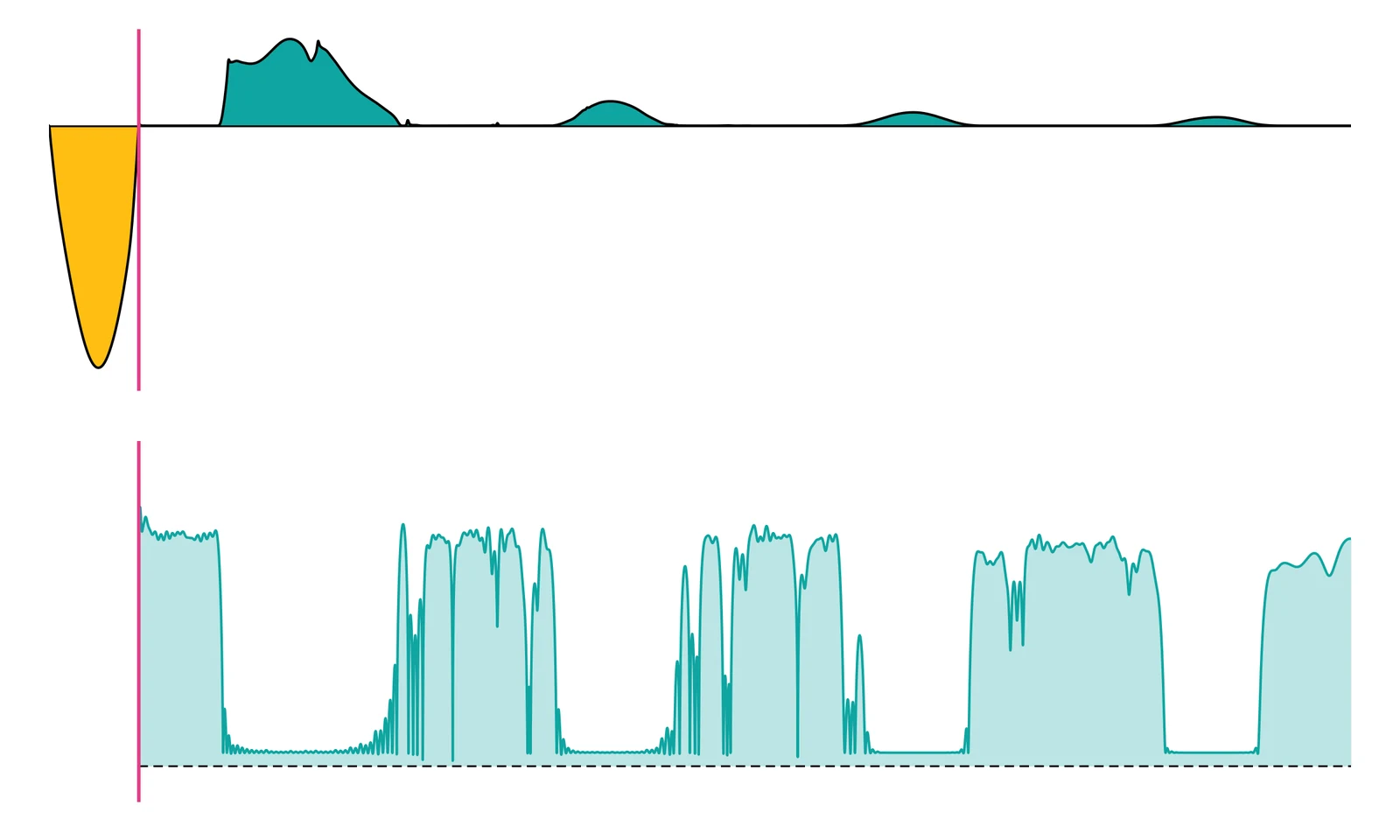
Bounds for the sign uncertainty constant in dimension one
In plain words
In 2010 Bourgain, Clozel and Kahane proved that a nonzero symmetric function and its Fourier transform, which records its frequencies, cannot both be at most zero at the origin and stay nonnegative beyond arbitrarily short distances from it. Determining the smallest possible product of the two distances is one of the problems collected by Georgiev, Gómez-Serrano, Tao and Wagner; it was known to lie between 0.2025 and 0.3089. The paper narrows it to between 0.3025 and 0.3037, proving part of a conjecture of Gonçalves, Oliveira e Silva and Ramos.
Abstract
Bourgain, Clozel and Kahane proved that a nonzero even real function f on the real line with f and f̂ integrable, f(0) ≤ 0 and f̂(0) ≤ 0 cannot have f and f̂ both nonnegative outside an arbitrarily small neighborhood of the origin. Let A(f) be the radius beyond which f is nonnegative, and let A+(1)2 be the largest constant such that A(f)A(f̂) ≥ A+(1)2 for all such f. This is the constant of Problem 6.11 in the list of Georgiev, Gómez-Serrano, Tao and Wagner, where f(0) < 0 and f̂(0) < 0 are required. The previous bounds are 0.2025 ≤ A+(1)2 ≤ 0.3089, due to Gonçalves, Oliveira e Silva and Steinerberger and to a computer search reported by Chung, Du and Wesley. We prove 11/20 < A+(1) ≤ 551/1000, so that A+(1)2 lies in (0.3025, 0.303601]. For the lower bound, since extremizers exist, it suffices to show that every even real integrable g with ĝ = g, g(0) ≤ 0 and g ≥ 0 on |x| > r vanishes. For such g we write g(0) = ∫|y|>r gW + Σk dk g(βk) + ∫−rr gρ with dk ≥ 0 and βk ≥ r. The weight W comes from explicit differences between Gaussians and their Fourier transforms and from cosines cos(2πβkx), corrected on [−r, r] by an approximate solution of a Fredholm integral equation, and ρ is the residual of this approximation. If W ≥ m > 0 on |y| > r and ρ is small compared with m, a bound for the Fredholm operator forces g = 0. Two separately written programs verify the required inequalities for r = 11/20 in ball arithmetic. The upper bound comes from an explicit self-dual combination of Gaussians whose positivity beyond 551/1000 is verified in the same way.