Positive correlation of bond energies in the O(3) and O(4) models
Abstract
We study the O(N) model on a finite graph and ask whether the scalar products σx·σy of two pairs of vertices, such as the bond energies of two edges, are positively correlated, a form of Griffiths' second inequality for scalar products of spins (Simon's Problem 5C). For all couplings we prove the inequality on several classes of graphs, which at N = 3 include the class of all graphs that have no minor isomorphic to the wheel W4 once the two pairs are joined by edges. For N = 3, 4 and uniform coupling we prove the inequality at every value of the coupling and for every pair of edges on the strips P3 × Pn, which have a W4 minor once n ≥ 3. The proofs combine two tools. The first consists of expansions of the edge weights into spin networks and, at N = 3, into powers of (1 + σx·σy)/2, an expansion in which total positivity of the label laws is carried along graphs without a W4 minor. The second is a transfer operator on the strips. Together with strong-coupling expansions on the whole graph of each short strip, it reduces positivity to finitely many inequalities, which are verified in rigorous computer arithmetic.
In plain words
In 1984 Barry Simon listed fifteen open problems in mathematical physics. One concerns spins, arrows that tend to align with their neighbours. Can strengthening the bond between two neighbours weaken the alignment of another pair of spins? Griffiths and Ginibre had answered no for spins pointing in one or two dimensions. When the second pair are neighbours, this paper answers no in two main cases. One covers three-dimensional spins on every network that avoids a small wheel-shaped pattern. The other covers three- and four-dimensional spins on strips three spins wide, where all bonds start equal before one is strengthened slightly.
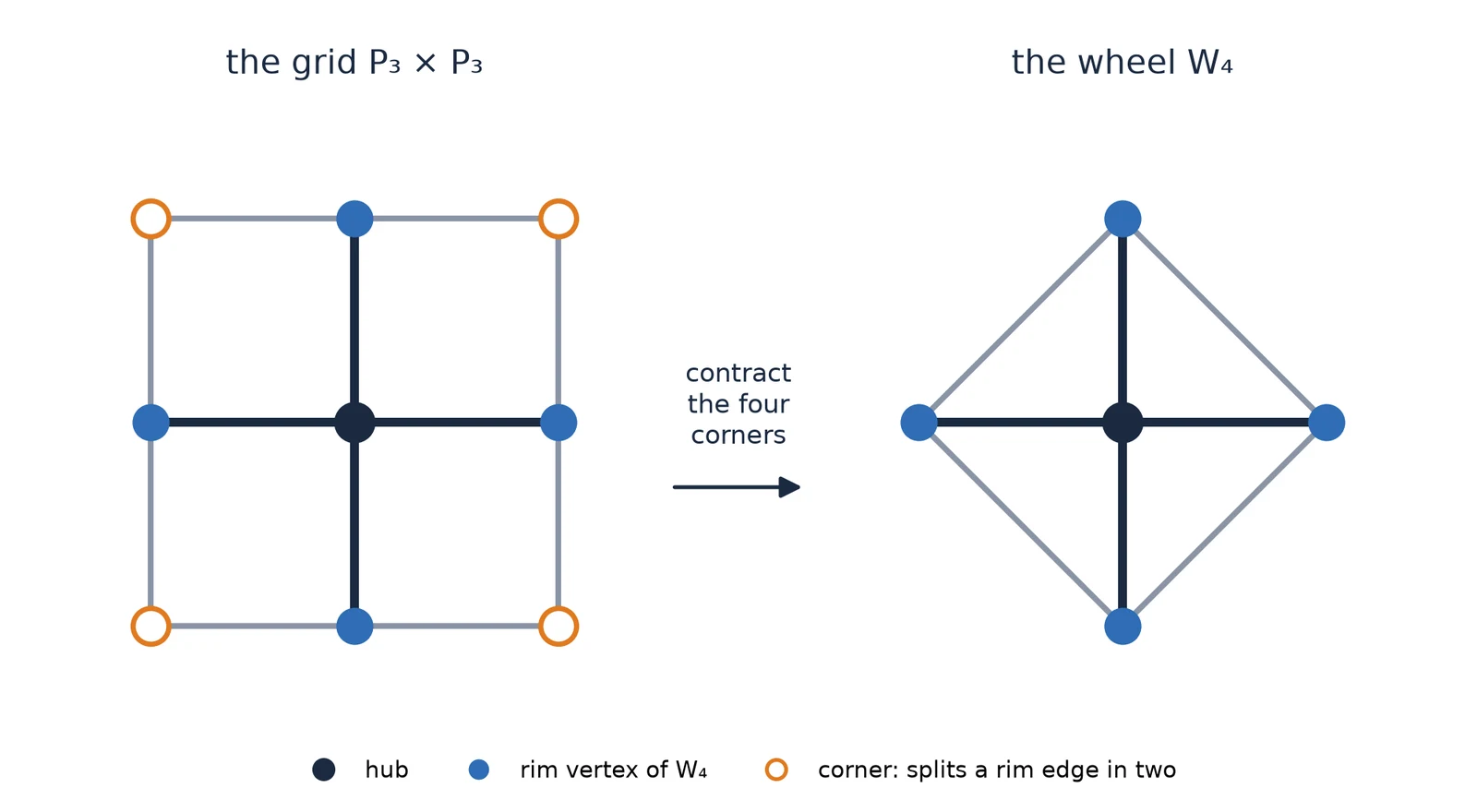
Formal statement and axioms
Each main result as stated in Lean, copied verbatim from the published package, with the axioms that the proof rests on. Lean v4.35.0-rc3, Mathlib c55e6e786f49. The package.
G2Kernel.cactus_thm
The deductions behind Theorems 1.1 [Theorem 1.1] and 1.4: kernel-only
theorem cactus_thm (N : ℕ) : cactus_statement NDefinitions used in the statement
def cactus_statement (N : ℕ) : Prop :=
  hSphereIso N →
  ∀ (k : ℕ → ℝ → ℝ) (d : ℕ → ℝ) (C : ℕ → ℝ → ℝ), hFH N k d C → hKReg k → hRatio k → hCycleZ N k d →
    ∀ (V : Type) [Fintype V] [DecidableEq V] (G : SimpleGraph V) [DecidableRel G.Adj], IsCactus G →
      ∀ J : Sym2 V → ℝ, Ferro G J →
∀ e ∈ G.edgeSet, ∀ f ∈ G.edgeSet, e ≠ f → G2pair N G J e fAxioms, as Lean reports them. Recorded in the published file.
'G2Kernel.cactus_thm' depends on axioms: [propext, Classical.choice, Quot.sound]G2Kernel.cactus_strict_thm
The deductions behind Theorems 1.1 [Theorem 1.1, its strict part] and 1.4: kernel-only
theorem cactus_strict_thm (N : ℕ) : cactus_strict_statement NDefinitions used in the statement
def cactus_strict_statement (N : ℕ) : Prop :=
  hSphereIso N →
  ∀ (k : ℕ → ℝ → ℝ) (d : ℕ → ℝ) (C : ℕ → ℝ → ℝ), hFH N k d C → hKReg k → hRatio k → hCycleZ N k d →
    (∀ c, 0 < d c) →
    ∀ (V : Type) [Fintype V] [DecidableEq V] (G : SimpleGraph V) [DecidableRel G.Adj] (L : List (CactusBlock V)),
      IsCactusWith G L → ∀ J : Sym2 V → ℝ, Ferro G J →
      ∀ (n : ℕ) (φ : Fin n → V), CactusBlock.cycle n φ ∈ L →
        (∀ g ∈ (CactusBlock.cycle n φ).edges, 0 < J g) →
        ∀ e ∈ (CactusBlock.cycle n φ).edges, ∀ f ∈ (CactusBlock.cycle n φ).edges, e ≠ f →
0 < gibbsCov N G J (bond e) (bond f)Axioms, as Lean reports them. Recorded in the published file.
'G2Kernel.cactus_strict_thm' depends on axioms: [propext, Classical.choice, Quot.sound]G2Kernel.fullStrip_thm
The deductions behind Theorems 1.1 and 1.4 [Theorem 1.4 (i)]: kernel-only
theorem fullStrip_thm (N : ℕ) :
    fullStrip_statementL N box5List (o5List ++ L55) (box5AllList34 ++ box5Stage2) m1List NMAX_M1 D0_M2 M0_M2
Definitions used in the statement
def fullStrip_statementL (N : ℕ) (L5 : List (ECode × ECode)) (L6 : List (ℕ × ECode × ECode)) (L2 : List (ECode × ECode))
    (L : List (ℕ × ECode × ECode)) (nmax D0 M0 : ℕ) : Prop :=
  (N = 3 ∨ N = 4) → hSphereIso N → hShared N → hRPGibbs N → hWeak N →
  ∀ md : StripModes, hStripIdentity N md → hStripCert N md →
  ∀ k : ℕ → ℝ → ℝ, hKReg k → hRatio k → hCornerFactor N k →
  hHub N → hLBu N → hLadder N → hRHCover N → hRHCover350 N →
  hStripMirror N → hVertSV N → hD4 N → hNE N → hBox5 N L5 → hS9h N → hS9i N → hO5 N L6 → hBoxAll5 N L2 → hM1 N L nmax →
  hM2tail N D0 M0 →
    ∀ n : ℕ, 1 ≤ n → ∀ J : ℝ, 0 ≤ J →
∀ e ∈ (strip n).edgeSet, ∀ f ∈ (strip n).edgeSet, e ≠ f → G2pair N (strip n) (uniform J) e fAxioms, as Lean reports them. Recorded in the published file.
'G2Kernel.fullStrip_thm' depends on axioms: [propext, Classical.choice, Quot.sound]5 more formal statements
G2Kernel.stripD_factor_thm
The deductions behind Theorems 1.1 and 1.4 [Theorem 1.4 (ii)]: kernel-only
theorem stripD_factor_thm (N : ℕ) : stripD_factor_statement NDefinitions used in the statement
def stripD_factor_statement (N : ℕ) : Prop :=
  (N = 3 ∨ N = 4) → hSphereIso N → hWeak N →
  ∀ md : StripModes, hStripIdentity N md → hStripCert N md → hStripSpecial N →
  ∀ k : ℕ → ℝ → ℝ, hKReg k → hRatio k → hCornerFactor N k →
    ∀ n : ℕ, 3 ≤ n → ∀ J : ℝ, 0 < J → J ≤ 20 →
      ∀ e ∈ (strip n).edgeSet, ∀ f ∈ (strip n).edgeSet, e ≠ f →
0 < gibbsCov N (strip n) (uniform J) (bond e) (bond f)Axioms, as Lean reports them. Recorded in the published file.
'G2Kernel.stripD_factor_thm' depends on axioms: [propext, Classical.choice, Quot.sound]G2Kernel.G2_P3P3_thm
The deductions ... behind parts (a) [part (a)], (b) for J ≤ 300, (e) and (f) of Theorem 6.34: kernel-only
theorem G2_P3P3_thm (N : ℕ) : G2_P3P3_statement NDefinitions used in the statement
def G2_P3P3_statement (N : ℕ) : Prop :=
  (N = 3 ∨ N = 4) → hSphereIso N → hShared N → hRPGibbs N → hWeak N →
  ∀ md : StripModes, hStripIdentity N md → hStripCert N md → hHub N → hLBu N →
∀ J : ℝ, 0 ≤ J → ∀ e ∈ grid33.edgeSet, ∀ f ∈ grid33.edgeSet, e ≠ f → G2pair N grid33 (uniform J) e fAxioms, as Lean reports them. Recorded in the published file.
'G2Kernel.G2_P3P3_thm' depends on axioms: [propext, Classical.choice, Quot.sound]G2Kernel.strip300_thm
The deductions ... behind parts (a), (b) for J ≤ 300 [part (b) for J ≤ 300], (e) and (f) of Theorem 6.34: kernel-only
theorem strip300_thm (N : ℕ) : strip300_statement NDefinitions used in the statement
def strip300_statement (N : ℕ) : Prop :=
  (N = 3 ∨ N = 4) → hSphereIso N → hShared N → hRPGibbs N → hWeak N →
  ∀ md : StripModes, hStripIdentity N md → hStripCert N md →
  ∀ k : ℕ → ℝ → ℝ, hKReg k → hRatio k → hCornerFactor N k →
  hHub N → hLBu N → hLadder N → hRHCover N →
    (∀ n : ℕ, 1 ≤ n → ∀ J : ℝ, 0 ≤ J → J ≤ 300 →
      ∀ e ∈ (strip n).edgeSet, ∀ f ∈ (strip n).edgeSet, e ≠ f → G2pair N (strip n) (uniform J) e f) ∧
    (∀ n : ℕ, 4 ≤ n → ∀ J : ℝ, 0 < J → J ≤ 300 →
      ∀ e ∈ (strip n).edgeSet, ∀ f ∈ (strip n).edgeSet, e ≠ f → ¬ sameColumn n e f →
0 < gibbsCov N (strip n) (uniform J) (bond e) (bond f))Axioms, as Lean reports them. Recorded in the published file.
'G2Kernel.strip300_thm' depends on axioms: [propext, Classical.choice, Quot.sound]G2Kernel.smallN_thm
The deductions ... behind parts (a), (b) for J ≤ 300, (e) [part (e)] and (f) of Theorem 6.34: kernel-only
theorem smallN_thm (N : ℕ) : smallN_statementL N (box5AllList34 ++ box5Stage2)Definitions used in the statement
def smallN_statementL (N : ℕ) (L : List (ECode × ECode)) : Prop :=
  (N = 3 ∨ N = 4) → hSphereIso N → hShared N → hRPGibbs N → hWeak N →
  ∀ md : StripModes, hStripIdentity N md → hStripCert N md →
  ∀ k : ℕ → ℝ → ℝ, hKReg k → hRatio k → hCornerFactor N k →
  hHub N → hLBu N → hLadder N → hRHCover N → hRHCover350 N →
  hStripMirror N → hVertSV N → hD4 N → hBoxAll5 N L →
    ∀ n : ℕ, 1 ≤ n → n ≤ 5 → ∀ J : ℝ, 0 ≤ J →
∀ e ∈ (strip n).edgeSet, ∀ f ∈ (strip n).edgeSet, e ≠ f → G2pair N (strip n) (uniform J) e fAxioms, as Lean reports them. Recorded in the published file.
'G2Kernel.smallN_thm' depends on axioms: [propext, Classical.choice, Quot.sound]G2Kernel.stripIII_thm
The deductions ... behind parts (a), (b) for J ≤ 300, (e) and (f) [part (f)] of Theorem 6.34: kernel-only
theorem stripIII_thm (N : ℕ) : stripIII_full_statementL N box5List (o5List ++ L55)Definitions used in the statement
def stripIII_full_statementL (N : ℕ) (L5 : List (ECode × ECode)) (L6 : List (ℕ × ECode × ECode)) : Prop :=
  (N = 3 ∨ N = 4) → hSphereIso N → hShared N → hRPGibbs N → hWeak N →
  ∀ md : StripModes, hStripIdentity N md → hStripCert N md →
  ∀ k : ℕ → ℝ → ℝ, hKReg k → hRatio k → hCornerFactor N k →
  hHub N → hLBu N → hLadder N → hRHCover N → hRHCover350 N →
  hStripMirror N → hVertSV N → hD4 N → hNE N → hBox5 N L5 → hS9h N → hS9i N → hO5 N L6 →
    ∀ n : ℕ, 1 ≤ n → ∀ J : ℝ, 0 ≤ J →
      ∀ e ∈ (strip n).edgeSet, ∀ f ∈ (strip n).edgeSet, e ≠ f → ¬ midRowEdge n e → ¬ midRowEdge n f →
G2pair N (strip n) (uniform J) e fAxioms, as Lean reports them. Recorded in the published file.
'G2Kernel.stripIII_thm' depends on axioms: [propext, Classical.choice, Quot.sound]