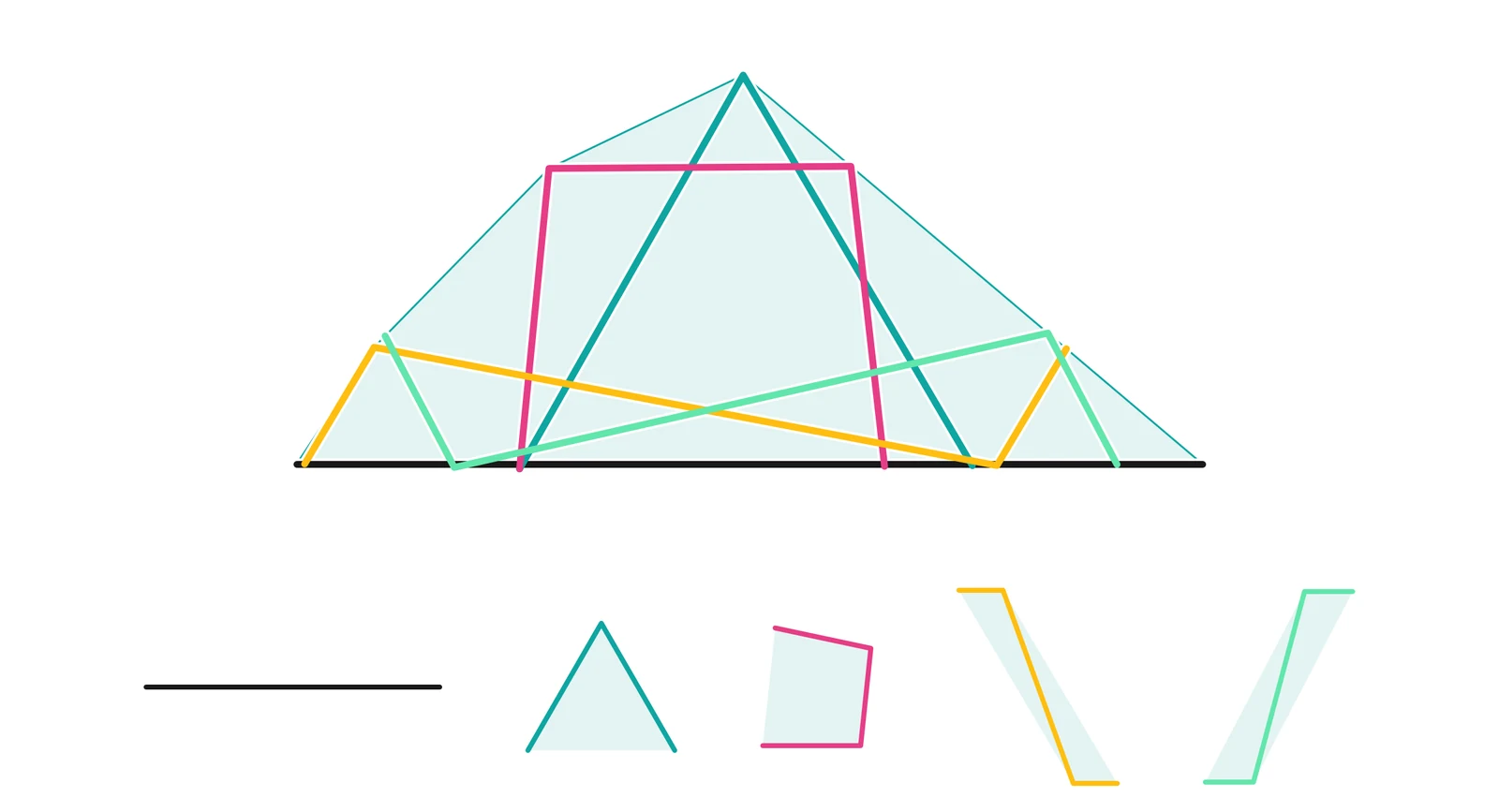
A lower bound for Moser's worm problem with rotations and translations
In plain words
Moser's worm problem asks for the smallest region that can hold a copy of every curve of length 1. This paper considers regions without dents, in which the copies may be turned and slid but not flipped. The best lower bound for their area was 0.239, which Keller proved in a 2026 preprint for the version that also allows flipping. Without flipping, the paper raises it to 0.2405, using five curves made of straight pieces. A computer search over all their positions produced a certificate of 203,209,418 cases, which a separate program checks with rigorous error bounds.
Abstract
Moser's worm problem asks for the least area of a convex set in the plane that contains a copy of every arc of length 1. We consider the version in which the copies may be rotated and translated but not reflected, and give a computer-assisted proof that the least area M+ satisfies M+ ≥ 0.2405. The previous lower bound, 0.239, was proved by Keller for the version with reflections and carries over to this one. Like the earlier lower bounds, ours uses that such a set contains the convex hull of copies of finitely many arcs. We take five polygonal arcs: a segment, an equilateral two-link arc, a three-link arc and two zigzag arcs that turn in opposite directions. Without reflections, a placed zigzag can serve only as a copy of the zigzags that turn in its own direction. On a box of placements we bound the hull area from below by signed areas of polygons spanned by vertices of the placed arcs. We bound these areas by second-order Taylor expansions with certified eigenvalue bounds and, where the hull changes its combinatorial type, by convex combinations of such bounds. Our branch and bound over a twelve-dimensional box of placements produced a certificate with 203,209,418 leaves, which a separate checker verifies in ball arithmetic.