A lower bound of 0.836 for Lebesgue's universal covering problem
In plain words
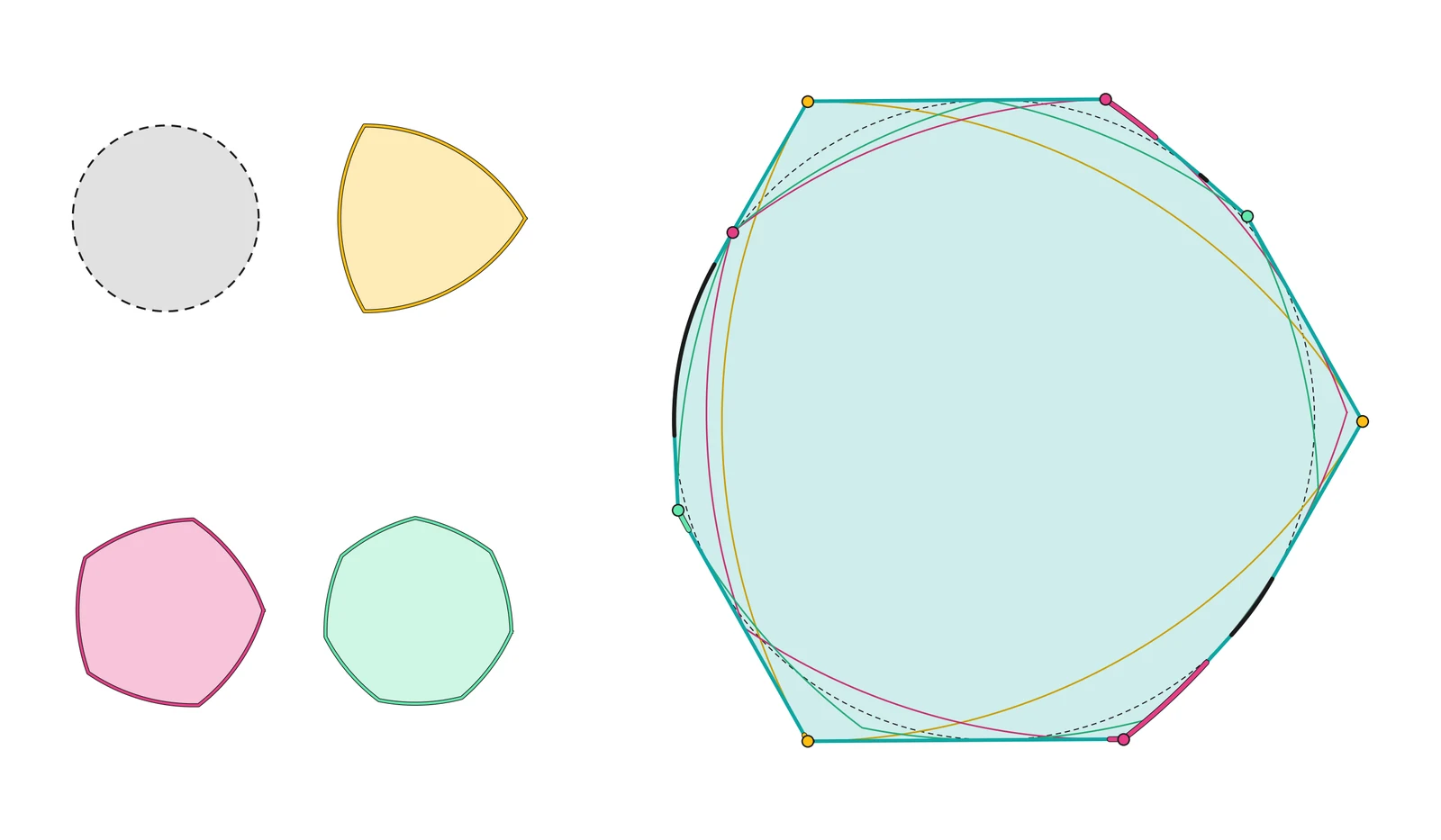
In 1914 Lebesgue asked for the least area of a convex patch that can be placed over every set of points in the plane at most 1 apart. Gibbs's patch of area 0.8441 is the smallest known. Lower bounds come from a few test shapes that a patch must hold at once. The best earlier bounds were 0.83474, by Hatchett, and 0.8344, by Mishra. Using a disk and the Reuleaux triangle, pentagon and heptagon, all of width 1, this paper raises the bound to 0.836, with a computer-checked certificate.
Abstract
A universal cover is a convex set in the plane that contains a congruent copy of every set of diameter 1. Lebesgue asked for the least area Λ of a universal cover. The best upper bound is Λ ≤ 0.8440935944, due to Gibbs. The previous lower bounds were Λ ≥ 0.83474, due to Hatchett, and Λ ≥ 0.8344, due to Mishra. We prove Λ ≥ 0.836. Like the earlier lower bounds, the proof uses the fact that a universal cover contains the convex hull of congruent copies of any finitely many sets of diameter 1. We use the disk and the regular Reuleaux triangle, pentagon and heptagon of width 1, whose relative placements form an eight-dimensional space. The main ingredient is a second-order lower bound for the hull area on a box of placements. We follow finitely many points of the bodies as they move. While these points stay in angular order around a point of the disk, the area of the polygon they span is at most the hull area. This area is a polynomial in the translations and in the sines and cosines of the angles of the placement. A Taylor expansion with a certified bound for the smallest eigenvalue of the Hessian bounds it on the whole box. A checker in ball arithmetic verifies the resulting certificate, which has 1,552,274 nodes.