Percolation is a model of water soaking into porous stone: grid points are open at random, and infinite open paths appear once the share of open points passes a threshold. In 1991 Aizenman and Grimmett studied local rules that open extra points around randomly chosen places. They argued that such a rule lowers the threshold if applying it at a single place can complete an open path that is infinite in both directions. In 2014 Balister, Bollobás and Riordan found a false step in that argument and repaired it in two and three dimensions. This paper’s proof covers every dimension from two up.
Abstract
In 1991 Aizenman and Grimmett gave an argument that an essential enhancement of percolation strictly lowers the critical probability. Balister, Bollobás and Riordan later found that a combinatorial lemma in that argument is false. They reduced the case of site percolation on Zd to a deterministic statement about rerouting paths, proved it for d = 2 and d = 3, and left the cases d ≥ 4 open. We prove their Conjecture 1 for site percolation on Zd for every d ≥ 2. The proof does not confine the enhancement gadget to the ball centred at the pivotal site. Instead it allows any ℓ1 ball that lies in a large ball around that site, has radius bounded below by a fixed constant, and meets the pivotal path in at least three sites. A two-port theorem, valid in every dimension, shows that the gadget can be wired in unless the first and last sites of the path in the ball form a corner pair. A compactness and mass-transport argument shows that some admissible ball avoids this configuration. As in the cases d = 2, 3, the result rests on the probabilistic part of the Aizenman–Grimmett argument. The deterministic part of the argument, Claim 5 of Balister, Bollobás and Riordan, is also checked in the Lean proof assistant for every d ≥ 2.
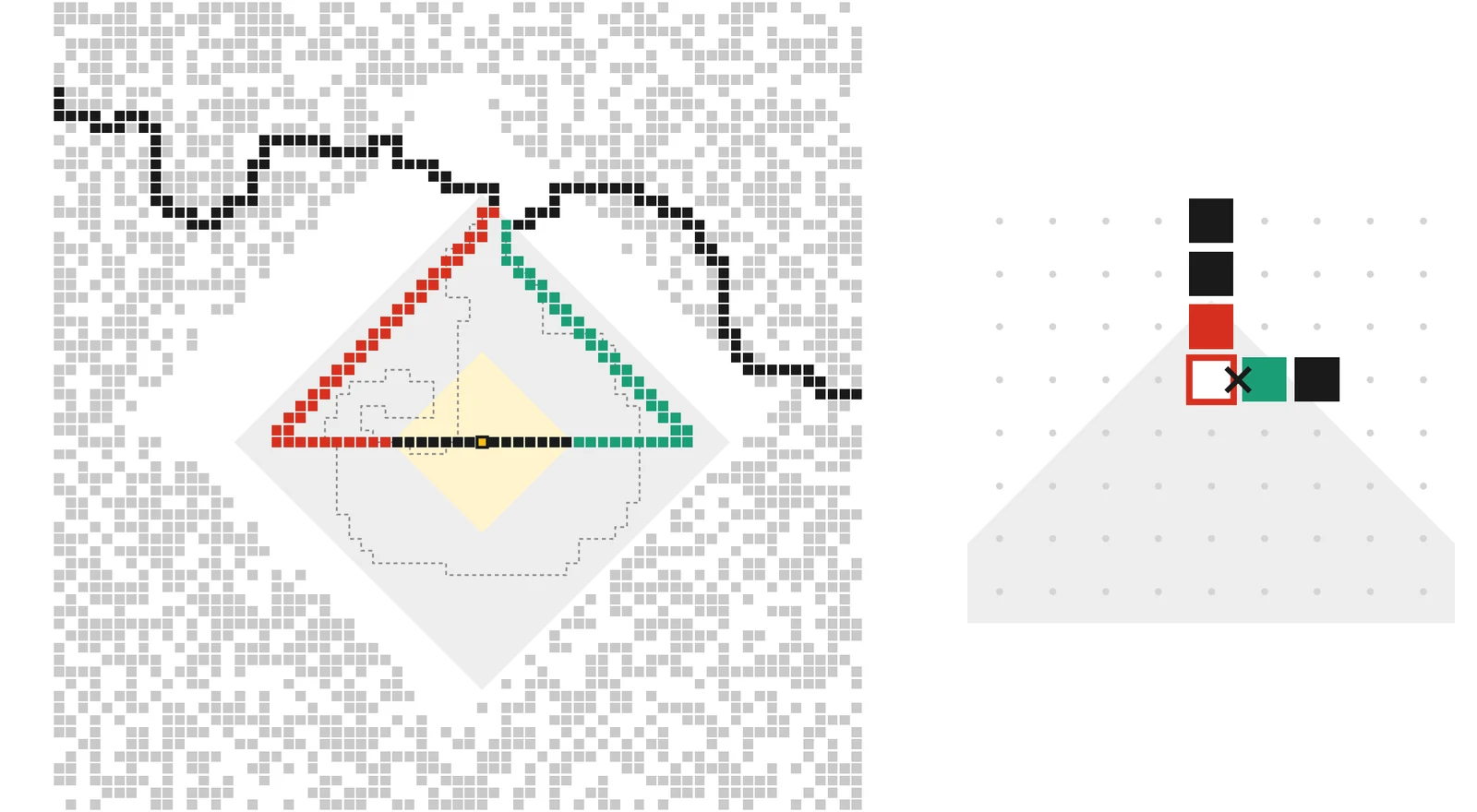
Illustration in the plane. Filled squares are open sites, except the yellow one, which is closed. Left: the deletion step of Balister, Bollobás and Riordan has cleared a large ℓ¹ ball Ω around a pivotal site. Inside Ω, only the sites of an induced path P (black) are open; outside Ω, sites are open at random (grey). The paper’s construction takes a second ℓ¹ ball D (light grey, radius 20) that lies inside Ω but is not centred at the pivotal site. P first enters D at a red site and last leaves it at a green site. The construction replaces the sites of P in D (dashed) with a red set and a green set that join these two sites to the ends of a gadget. In this illustration, when the enhancement acts at a site whose left and right neighbours are open, it opens that site. The gadget (black, on the pale yellow ball of radius 7) is the row formed by the seven sites on each side of the centre of D. The centre stays closed and no red site is adjacent to a green one, so the ends of P are not joined. They are joined when the enhancement acts at the centre and opens it. Right: a corner pair, in which P meets a ball first at one of the ball’s corners (red) and last at a green site diagonally next to that corner. A red set from the corner would have to pass through the outlined site, the corner’s only neighbour in the ball. That site is adjacent to the green site, so there are no red and green sets like those on the left.