A power series that stays at most one in size on the unit disc has terms whose sizes sum to at most one on the disc of radius one third, a result of Riesz, Schur and Wiener given in Bohr's paper of 1914. For two variables the best such radius, the Bohr radius of the bidisc, is unknown. In an unrefereed solution posted on MathDB, Patel showed that it exceeds 0.30158758. This paper confirms his argument and, with computer-checked estimates for polynomials of degrees five and six, raises the lower bound to 0.301657.
Abstract
The Bohr radius K2 of the bidisc is the largest r such that every holomorphic f(z) = Σ cα zα on the bidisc with |f| ≤ 1 satisfies Σ |cα| r|α| ≤ 1, and its exact value is unknown. In an unrefereed solution posted on MathDB, Patel proved K2 > 0.30158758. His argument combines three inequalities for the coefficients of degrees two and three, one of which comes from the unitary realization of Schur functions on the bidisc, with Knese's bound in the higher degrees. We present his argument in full detail, confirm that it is correct, and check its exact computation. Knese's bound in degree n carries the factor √n, and this factor can be replaced by the Sidon constant of {0, 1, …, n}, which is smaller than √n for every n ≥ 5 by a theorem of Shapiro. We prove the computer-assisted bounds S({0, 1, …, 5}) ≤ 2.187, consistent with the exact value found by Ye et al., and S({0, 1, …, 6}) ≤ 2.363. With them we obtain K2 > 0.301657. The numerical steps use exact rational arithmetic and ball arithmetic.
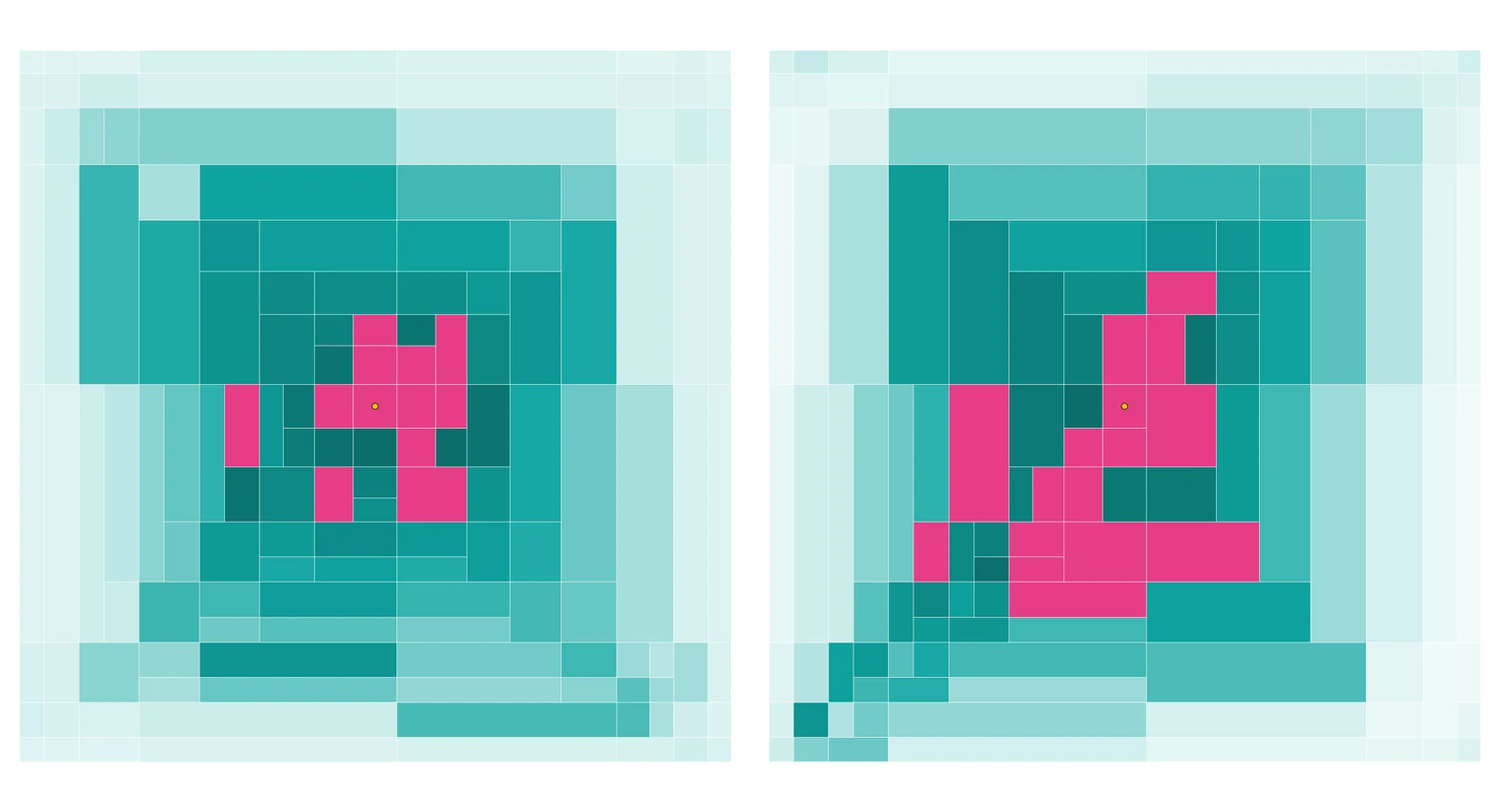
Illustration of the certificate for the Sidon-constant bound S({0, 1, …, 5}) ≤ 2.187. By Lemma 4.1 of the paper it is enough to bound a phase functional ν at the vectors (1, 1, e^{iφ₂}, …, e^{iφ₅}). The certificate covers the phases (φ₂, …, φ₅) by 8,912 boxes, cut from a grid of 8⁴ cells by repeated halving. Over a box each e^{iφⱼ} stays on an arc inside a triangle, and for each of the 81 ways to pick one corner from each of the four triangles the certificate gives a matrix that bounds ν there by 2.187. Shown are two slices through one of two mirror-image boxes (all phases negated) where the bound is tightest, centred at the phases (−π/128, −π/128, 127π/128, −π/128): left, the boxes met when (φ₄, φ₅) is fixed at that centre, drawn over (φ₂, φ₃); right, the boxes met when (φ₂, φ₃) is fixed, drawn over (φ₄, φ₅). Each axis is the full circle of phases, centred on the yellow dot and stretched near it so that the smallest boxes, π/64 wide, are visible. A box is shaded darker the smaller its margin, 2.187² minus the largest of the bounds on ν² that its 81 corner matrices give, and magenta where that margin is below 10⁻³; the smallest margin, about 1.49·10⁻⁵, is in the box at the dot. With the companion bound S({0, 1, …, 6}) ≤ 2.363, these bounds replace the factors √5 and √6 of Knese's estimate in Patel's argument and give K₂ > 0.301657. The margins are computed here in floating point; the paper's checker works in ball arithmetic.