Bounds for the smallest limit point of the areal Mahler measure of totally positive algebraic integers
In plain words
Totally positive algebraic integers are those whose polynomial has only positive roots. Pritsker's areal Mahler measure, taken per degree of that polynomial, gauges their size like the ordinary Mahler measure but averages over a disc rather than a circle. Flammang proved in 2015 that, apart from a few listed exceptions, it is at least 1.380047 for such integers. Using the methods of two companion papers on the ordinary measure, this paper places the smallest value at which these areal measures accumulate between 1.3830134 and 1.3842933. No earlier upper bound appears to be known.
Abstract
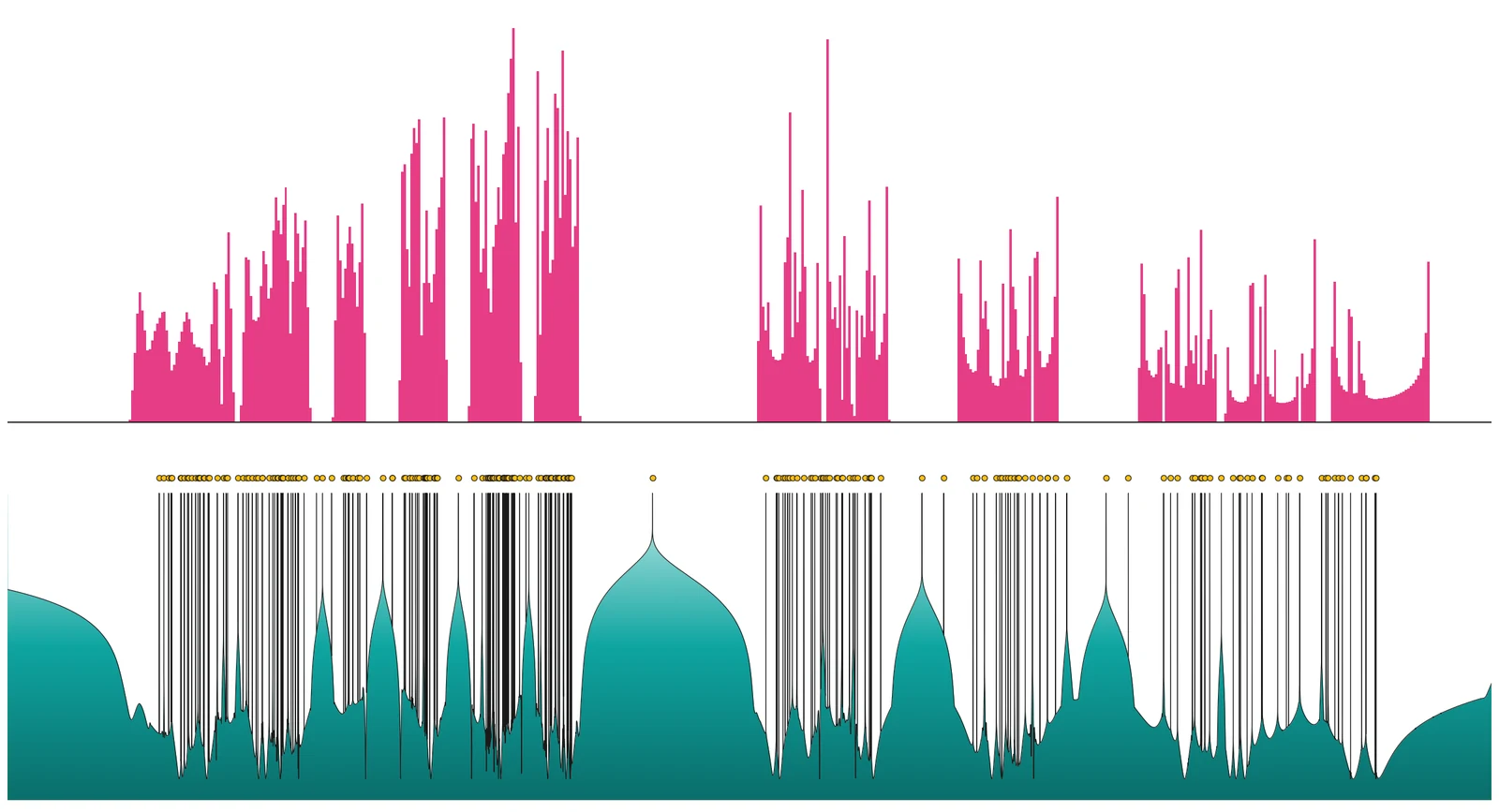
Pritsker's areal analog of the Mahler measure replaces the integral of log|P| over the unit circle by its integral over the unit disc with respect to normalized area. For an algebraic number α of degree n whose minimal polynomial P in Z[x] is primitive with positive leading coefficient, let N0(α) = ‖P‖01/n. Flammang proved that N0(α) ≥ 1.380047 for every totally positive algebraic integer α outside an explicit finite set. We prove that all but finitely many totally positive algebraic numbers satisfy N0(α) > 1.3830134, and that infinitely many totally positive algebraic integers satisfy N0(α) < 1.3842933. So the smallest limit point of the values of N0 on totally positive algebraic integers, and the essential minimum, lie between 1.3830134 and 1.3842933; we are not aware of an earlier upper bound. The lower bound comes from an auxiliary function with Flammang's polynomials and a logarithmic energy term, and the upper bound from a measure that satisfies a criterion of Smith, as in our two papers on the classical Mahler measure of totally positive algebraic integers. Both certificates are verified in ball arithmetic.