Which Fine-Grained Lower Bounds Survive the Refutation of 3SUM and APSP?
In plain words
For two decades, many speed limits in computing were proved under two assumptions: that the textbook methods are essentially optimal both for finding three numbers in a list that sum to zero and for finding all shortest paths in a network with whole-number link lengths. In October 2026, Alman and Vassilevska Williams disproved both assumptions in their standard forms, with methods whose advantage is small but grows with input size. This paper sorts the main speed limits: most follow from other assumptions that nothing contradicts, a few are false, and the rest have lost their support.
Abstract
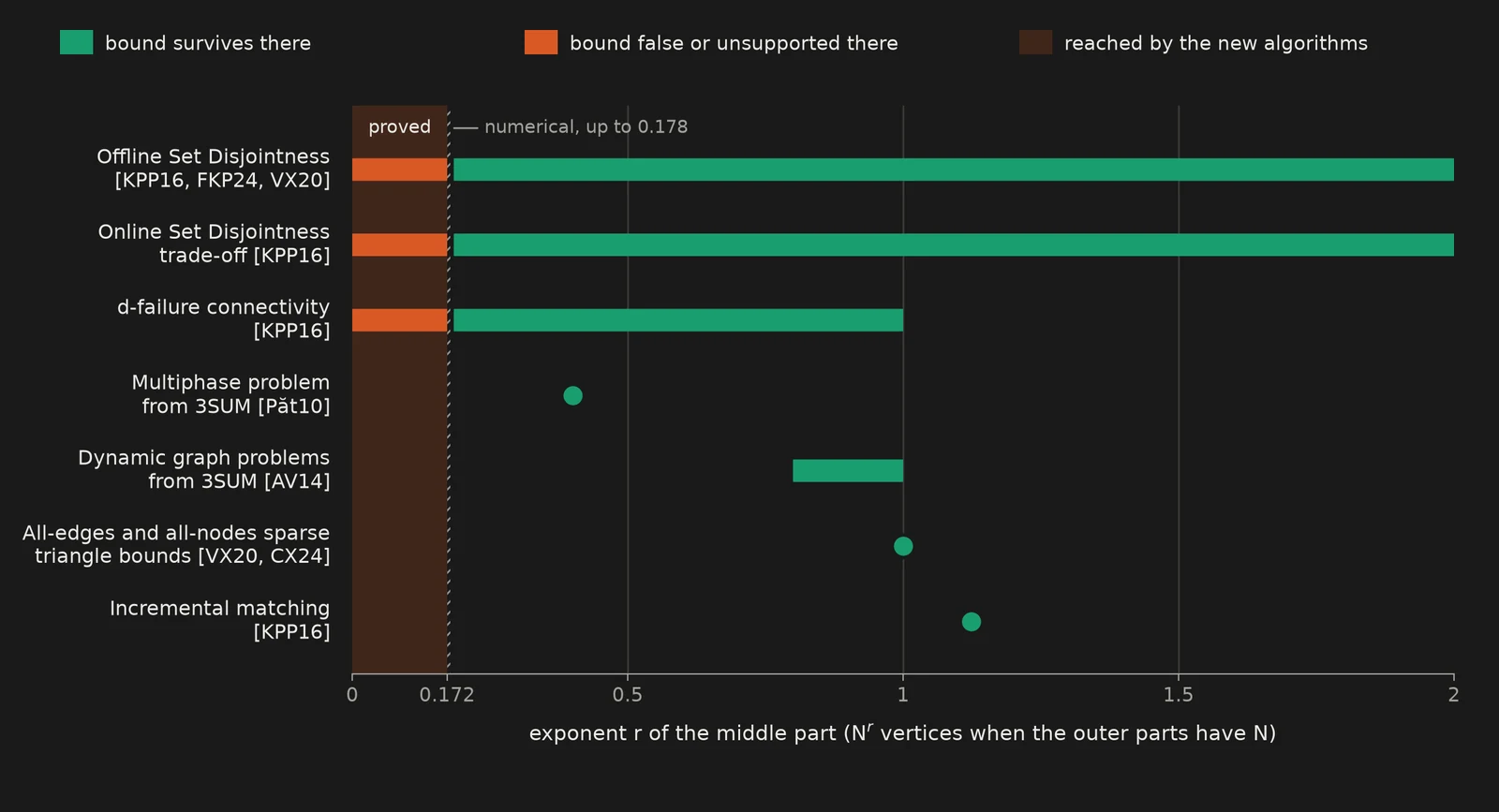
In October 2026 Alman and Vassilevska Williams refuted the 3SUM and APSP hypotheses, and with them the Exact Triangle, 3XOR, weighted k-Clique and (min,+)-convolution hypotheses. Their algorithm counts triangles through prescribed edges in lopsided tripartite graphs whose middle part has nε vertices for small ε, and Majdoddin extended its range to every ε < ln 4/(5 ln 5) ≈ 0.17227. Many conditional lower bounds were derived from the refuted hypotheses. We classify the main ones. Most of them were proved through All-Edges Sparse Triangle or offline Set Disjointness on instances that the new algorithms do not reach, namely balanced graphs and lopsided graphs with a larger middle part. We state the hypotheses that these reductions use, among them a family LSTHδ for the natural lopsided instances with middle part nδ, a lopsided form for listing a bounded number of triangles, and degree-bounded, all-nodes and batched forms of the hypothesis for balanced graphs. Most set-disjointness, dynamic-graph and triangle bounds follow from these hypotheses. In contrast, a lower bound of Goldstein, Lewenstein and Porat for Set Disjointness over small universes is false, and the trade-offs of Kopelowitz, Pettie and Porat lose their support where they use middle parts below n0.17227. The quadratic bounds for most 3SUM-hard problems in computational geometry, for jumbled indexing and for local alignment over large alphabets are unsupported. We also observe that 3SUM-Indexing now has a data structure with truly subquadratic preprocessing time and truly sublinear expected query time. Finally, we record why the closed-form analysis of the new method stops at ln 4/(5 ln 5), and we use border-rank lower bounds to exclude several natural kinds of base identity that might give a larger range.