Certified lower bounds on the optimal-decoding threshold of the surface code
Abstract
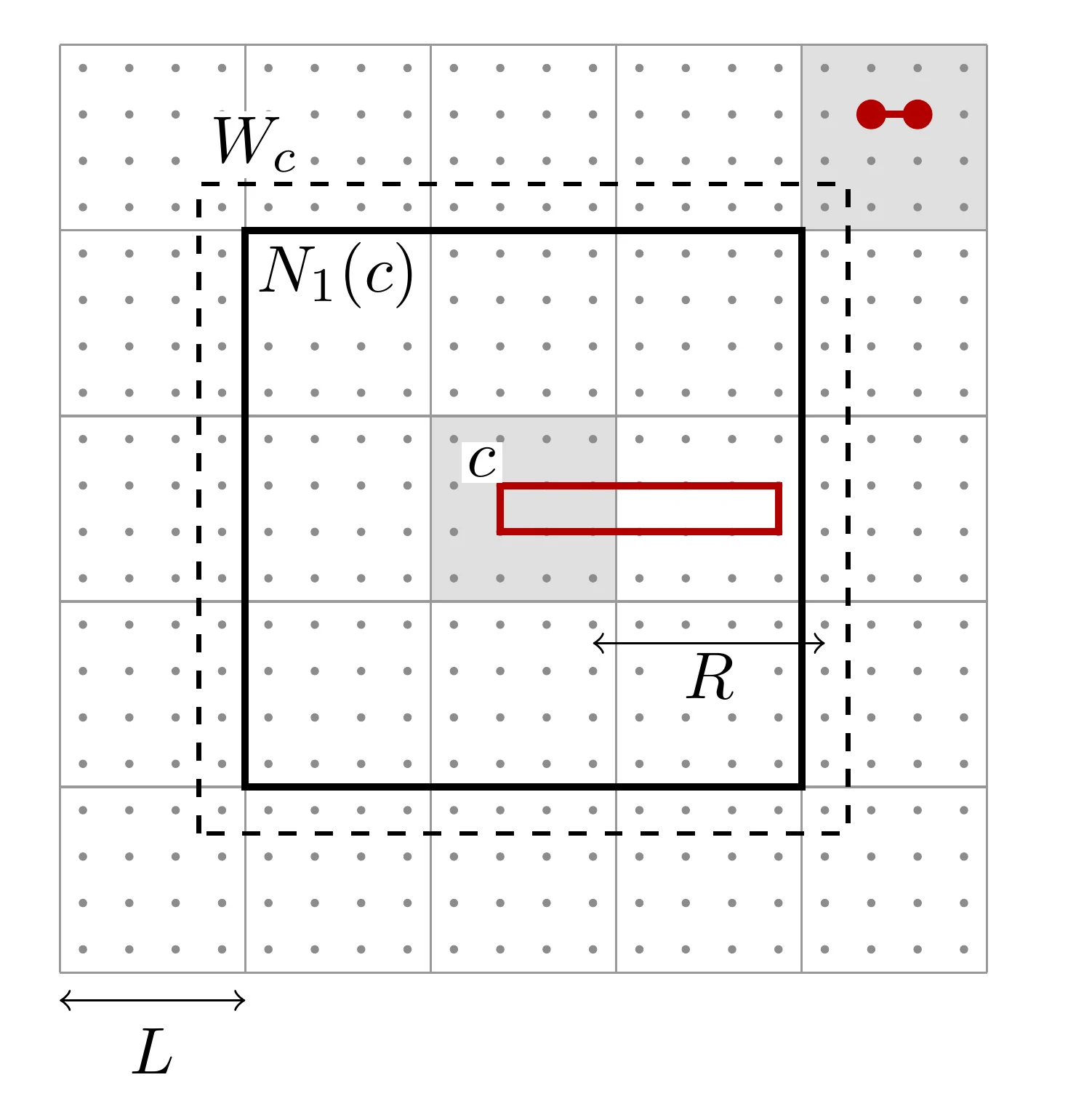
Under independent bit flips, rigorous lower bounds on the threshold of the surface code from earlier work stay below 0.04, while numerical estimates place the optimal threshold near 0.109. By counting labelled failure paths with exact transfer-matrix certificates, we prove without sampling that every minimum-weight decoder has threshold at least 0.0465 on the planar and rotated codes. We then give statistical certificates that the optimal threshold of the planar code is at least 0.102 under bit flips and at least 0.02 under phenomenological noise. Each certificate bounds an auxiliary decoder that corrects each block from a window around it, and optimal decoding does at least as well. A deterministic lemma reduces the failure of the auxiliary decoder to rare bad blocks, whose probabilities are bounded by a pre-registered Monte Carlo experiment. The confidence holds under a binomial model of the counts and two tested properties of each decoding program. All these results are proved in the proof assistant Lean 4, the statistical ones with these conditions as hypotheses.
In plain words
The surface code protects data on quantum chips if their error rate is below a threshold. When bit flips occur independently and the checks themselves are error-free, simulations put the best correction method's threshold near 10.9%. But proven thresholds in this setting, including one by Dennis, Kitaev, Landahl and Preskill, stayed below 4%. This paper proves, without sampling, a threshold of at least 4.65% for the standard correction method on the rotated and unrotated codes. For the best method on the unrotated code, a proof and a pre-registered computer experiment certify a threshold of at least 10.2%. Under stated conditions, the chance of certifying such a bound when it is false is at most one in a billion.