Sorting networks on 15 and 16 inputs need 55 and 60 comparators, and 20 inputs need 81
Abstract
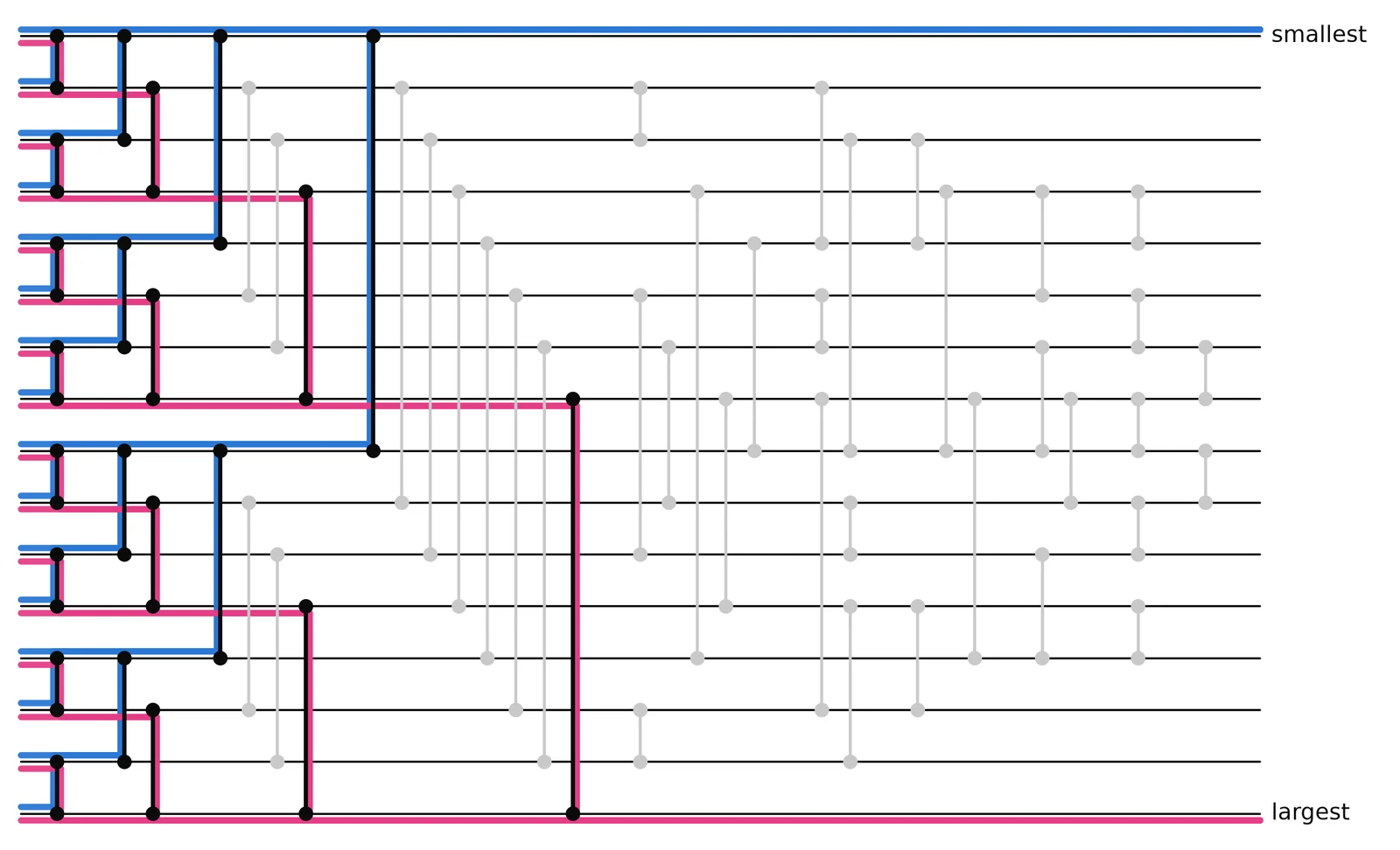
Let S(N) be the least number of comparators in a sorting network on N inputs. We prove that S(16) = 60, so the sorting network with 60 comparators that Green found in 1969 has the fewest possible comparators. We also prove that S(15) ≥ 55, which leaves 55 and 56 as the possible values of S(15), and that S(20) ≥ 81. Together, these results raise the previously known lower bounds on S(N) for 17 ≤ N ≤ 32 by two for even N ≥ 20 and by one otherwise. The lower bounds for 16 and 20 inputs come from a rigidity argument: in a sorting network with one comparator fewer than the bound to be proved, the lower bounds for fewer inputs, among them S(15) ≥ 55 at 16 inputs and S(16) ≥ 60 at 20 inputs, fix the comparators through which the two largest and the two smallest values pass, wherever they enter, up to an explicit list of choices, and a computation rules out each choice. At 20 inputs, fixing these comparators also needs a search over the ways in which the two largest values can pass through the network. The proof of S(15) ≥ 55 follows the method of our computer-assisted proof of S(14) ≥ 50 and adds new lower bounds of Huffman type on the number of comparators needed to sort a set of vectors. Separately written programs check the computations. In Lean 4 we prove one step of the argument for S(15) ≥ 55 and derive the three results, assuming only two tables of bounds from our proof of S(14) ≥ 50 that are certified outside Lean; some steps are evaluated by compiled code rather than by Lean's kernel.
In plain words
A sorting network puts numbers in order using a fixed sequence of compare-and-swap steps. Because the sequence never depends on the numbers, such networks are well suited to parallel sorting and to secure computation between several parties. In 1969 Green found a network that sorts 16 numbers in 60 steps, but no one could rule out a shorter one. This paper proves that none exists. It also shows that 15 numbers need at least 55 steps and 20 numbers at least 81. The best network known for 15 numbers uses 56.
Formal statement and axioms
Each main result as stated in Lean, copied verbatim from the published package, with the axioms that the proof rests on. Lean v4.35.0-rc3, Mathlib c55e6e786f49. The package.
Sortnet.S15.S15_ge_55_N
S(15) ≥ 55: with compiled code
theorem Sortnet.S15.S15_ge_55_N :
    Sortnet.S14.coreTableC.Valid →
    (∀ i ∈ Sortnet.S14.Wed.done, (Sortnet.S14.Wed.TLf i).Valid) →
    Sortnet.S15.S15Statement
Definitions used in the statement
def S15Statement : Prop := ∀ net : Network 15, net.Sorts → 55 ≤ net.lengthstructure Comparator (n : Nat) where
i : Fin n
j : Fin n
lt : i < j
deriving DecidableEqdef Comparator.apply {n : Nat} (c : Comparator n) (v : Fin n → Nat) : Fin n → Nat :=
fun k => if k = c.i then min (v c.i) (v c.j) else if k = c.j then max (v c.i) (v c.j) else v kabbrev Network (n : Nat) := List (Comparator n)def Network.eval {n : Nat} (net : Network n) (v : Fin n → Nat) : Fin n → Nat :=
net.foldl (fun w c => c.apply w) vdef Network.Sorts {n : Nat} (net : Network n) : Prop :=
∀ v : Fin n → Nat, ∀ a b : Fin n, a ≤ b → net.eval v a ≤ net.eval v bdef bitSet (n K : ℕ) : Set (Vec n) := {v | Nat.testBit K (code v) = true}structure Table where
cnt : ℕ
ent : ℕ → ℕ × ℕ × ℕdef Table.Valid (T : Table) : Prop :=
∀ i < T.cnt, ((T.ent i).1 = 10 ∨ (T.ent i).1 = 11) → LB (bitSet (T.ent i).1 (T.ent i).2.1) (T.ent i).2.2Source: Zenodo record 24156534, lean_tools.tar.gz/lean_tools/assembly_n/S15AssemblyN.lean:45-48.
Axioms, as Lean reports them: propext, Classical.choice, Quot.sound and 269,587 more, for example Sortnet.certOK_harder11._native.native_decide.ax_1_1, Sortnet.S14.CSD.n_V2164_10._native.native_decide.ax_1_1 and Sortnet.S14.CSD.n_V2202_12._native.native_decide.ax_1_1. Each of these 269,587 axioms comes from a check that runs as compiled code (native_decide). The full report is recorded in zenodo:24156534/lean_tools.tar.gz/lean_tools/axioms/S15_ge_55_N.txt:1-269590.
Sortnet.S16.S16_eq_60_N
S(16) = 60: with compiled code
theorem Sortnet.S16.S16_eq_60_N :
    Sortnet.S14.coreTableC.Valid →
    (∀ i ∈ Sortnet.S14.Wed.done, (Sortnet.S14.Wed.TLf i).Valid) →
    Sortnet.S16.S16Statement ∧ ∃ net : Sortnet.Network 16, net.Sorts ∧ net.length = 60
Definitions used in the statement
def S16Statement : Prop := ∀ net : Network 16, net.Sorts → 60 ≤ net.lengthstructure Comparator (n : Nat) where
i : Fin n
j : Fin n
lt : i < j
deriving DecidableEqdef Comparator.apply {n : Nat} (c : Comparator n) (v : Fin n → Nat) : Fin n → Nat :=
fun k => if k = c.i then min (v c.i) (v c.j) else if k = c.j then max (v c.i) (v c.j) else v kabbrev Network (n : Nat) := List (Comparator n)def Network.eval {n : Nat} (net : Network n) (v : Fin n → Nat) : Fin n → Nat :=
net.foldl (fun w c => c.apply w) vdef Network.Sorts {n : Nat} (net : Network n) : Prop :=
∀ v : Fin n → Nat, ∀ a b : Fin n, a ≤ b → net.eval v a ≤ net.eval v bdef bitSet (n K : ℕ) : Set (Vec n) := {v | Nat.testBit K (code v) = true}structure Table where
cnt : ℕ
ent : ℕ → ℕ × ℕ × ℕdef Table.Valid (T : Table) : Prop :=
∀ i < T.cnt, ((T.ent i).1 = 10 ∨ (T.ent i).1 = 11) → LB (bitSet (T.ent i).1 (T.ent i).2.1) (T.ent i).2.2Source: Zenodo record 24156534, lean_tools.tar.gz/lean_tools/assembly_n/S16EqAssemblyN.lean:70-73.
Axioms, as Lean reports them: propext, Classical.choice, Quot.sound and 269,608 more, for example Sortnet.certOK_harder11._native.native_decide.ax_1_1, Sortnet.S16.checkL1_ok._native.native_decide.ax_1_1 and Sortnet.S16.orbit0_ok._native.native_decide.ax_1_1. Each of these 269,608 axioms comes from a check that runs as compiled code (native_decide). The full report is recorded in zenodo:24156534/lean_tools.tar.gz/lean_tools/axioms/S16_eq_60_N.txt:1-269611.
Sortnet.S20.S20_ge_81_N
S(20) ≥ 81: with compiled code
theorem Sortnet.S20.S20_ge_81_N :
    Sortnet.S14.coreTableC.Valid →
    (∀ i ∈ Sortnet.S14.Wed.done, (Sortnet.S14.Wed.TLf i).Valid) →
    Sortnet.S20.S20Statement
Definitions used in the statement
def S20Statement : Prop := ∀ net : Network 20, net.Sorts → 81 ≤ net.lengthstructure Comparator (n : Nat) where
i : Fin n
j : Fin n
lt : i < j
deriving DecidableEqdef Comparator.apply {n : Nat} (c : Comparator n) (v : Fin n → Nat) : Fin n → Nat :=
fun k => if k = c.i then min (v c.i) (v c.j) else if k = c.j then max (v c.i) (v c.j) else v kabbrev Network (n : Nat) := List (Comparator n)def Network.eval {n : Nat} (net : Network n) (v : Fin n → Nat) : Fin n → Nat :=
net.foldl (fun w c => c.apply w) vdef Network.Sorts {n : Nat} (net : Network n) : Prop :=
∀ v : Fin n → Nat, ∀ a b : Fin n, a ≤ b → net.eval v a ≤ net.eval v bdef bitSet (n K : ℕ) : Set (Vec n) := {v | Nat.testBit K (code v) = true}structure Table where
cnt : ℕ
ent : ℕ → ℕ × ℕ × ℕdef Table.Valid (T : Table) : Prop :=
∀ i < T.cnt, ((T.ent i).1 = 10 ∨ (T.ent i).1 = 11) → LB (bitSet (T.ent i).1 (T.ent i).2.1) (T.ent i).2.2Source: Zenodo record 24156534, lean_tools.tar.gz/lean_tools/assembly_n/S20AssemblyN.lean:71-74.
Axioms, as Lean reports them: propext, Classical.choice, Quot.sound and 269,641 more, for example Sortnet.certOK_harder11._native.native_decide.ax_1_1, Sortnet.S16.checkL1_ok._native.native_decide.ax_1_1 and Sortnet.S16.orbit0_ok._native.native_decide.ax_1_1. Each of these 269,641 axioms comes from a check that runs as compiled code (native_decide). The full report is recorded in zenodo:24156534/lean_tools.tar.gz/lean_tools/axioms/S20_ge_81_N.txt:1-269644.
2 more formal statements
Sortnet.T6.table6Lo_N
the paper’s lower bounds for 17 ≤ N ≤ 27: with compiled code
theorem Sortnet.T6.table6Lo_N :
    Sortnet.S14.coreTableC.Valid →
    (∀ i ∈ Sortnet.S14.Wed.done, (Sortnet.S14.Wed.TLf i).Valid) →
    Sortnet.T6.Table6Lo
Definitions used in the statement
def Table6Lo : Prop :=
  Sortnet.S20.S17Statement ∧ Sortnet.S20.S18Statement ∧ Sortnet.S20.S19Statement ∧ Sortnet.S20.S20Statement ∧
    S21Statement ∧ S22Statement ∧ S23Statement ∧ S24Statement ∧ S25Statement ∧ S26Statement ∧ S27Statement
def S17Statement : Prop := ∀ net : Network 17, net.Sorts → 65 ≤ net.lengthdef S18Statement : Prop := ∀ net : Network 18, net.Sorts → 70 ≤ net.lengthdef S19Statement : Prop := ∀ net : Network 19, net.Sorts → 75 ≤ net.lengthdef S20Statement : Prop := ∀ net : Network 20, net.Sorts → 81 ≤ net.lengthdef S21Statement : Prop := ∀ net : Network 21, net.Sorts → 86 ≤ net.lengthdef S22Statement : Prop := ∀ net : Network 22, net.Sorts → 92 ≤ net.lengthdef S23Statement : Prop := ∀ net : Network 23, net.Sorts → 97 ≤ net.lengthdef S24Statement : Prop := ∀ net : Network 24, net.Sorts → 103 ≤ net.lengthdef S25Statement : Prop := ∀ net : Network 25, net.Sorts → 108 ≤ net.lengthdef S26Statement : Prop := ∀ net : Network 26, net.Sorts → 114 ≤ net.lengthdef S27Statement : Prop := ∀ net : Network 27, net.Sorts → 119 ≤ net.lengthstructure Comparator (n : Nat) where
i : Fin n
j : Fin n
lt : i < j
deriving DecidableEqdef Comparator.apply {n : Nat} (c : Comparator n) (v : Fin n → Nat) : Fin n → Nat :=
fun k => if k = c.i then min (v c.i) (v c.j) else if k = c.j then max (v c.i) (v c.j) else v kabbrev Network (n : Nat) := List (Comparator n)def Network.eval {n : Nat} (net : Network n) (v : Fin n → Nat) : Fin n → Nat :=
net.foldl (fun w c => c.apply w) vdef Network.Sorts {n : Nat} (net : Network n) : Prop :=
∀ v : Fin n → Nat, ∀ a b : Fin n, a ≤ b → net.eval v a ≤ net.eval v bdef bitSet (n K : ℕ) : Set (Vec n) := {v | Nat.testBit K (code v) = true}structure Table where
cnt : ℕ
ent : ℕ → ℕ × ℕ × ℕdef Table.Valid (T : Table) : Prop :=
∀ i < T.cnt, ((T.ent i).1 = 10 ∨ (T.ent i).1 = 11) → LB (bitSet (T.ent i).1 (T.ent i).2.1) (T.ent i).2.2Source: Zenodo record 24156534, lean_tools.tar.gz/lean_tools/assembly_n/T6AssemblyN.lean:70-73.
Axioms, as Lean reports them: propext, Classical.choice, Quot.sound and 269,644 more, for example Sortnet.certOK_harder11._native.native_decide.ax_1_1, Sortnet.S16.checkL1_ok._native.native_decide.ax_1_1 and Sortnet.S16.orbit0_ok._native.native_decide.ax_1_1. Each of these 269,644 axioms comes from a check that runs as compiled code (native_decide). The full report is recorded in zenodo:24156534/lean_tools.tar.gz/lean_tools/axioms/table6Lo_N.txt:1-269647.
Sortnet.S16.green_sorts
kernel-only for the proof that Green’s network sorts
theorem green_sorts : greenNet.SortsDefinitions used in the statement
def greenNet : Network 16 :=
  [gc 0 1, gc 2 3, gc 4 5, gc 6 7, gc 8 9, gc 10 11, gc 12 13, gc 14 15,
   gc 0 2, gc 1 3, gc 4 6, gc 5 7, gc 8 10, gc 9 11, gc 12 14, gc 13 15,
   gc 0 4, gc 1 5, gc 2 6, gc 3 7, gc 8 12, gc 9 13, gc 10 14, gc 11 15,
   gc 0 8, gc 1 9, gc 2 10, gc 3 11, gc 4 12, gc 5 13, gc 6 14, gc 7 15,
   gc 5 10, gc 6 9, gc 3 12, gc 13 14, gc 7 11, gc 1 2, gc 4 8,
   gc 1 4, gc 7 13, gc 2 8, gc 11 14, gc 5 6, gc 9 10,
   gc 2 4, gc 11 13, gc 3 8, gc 7 12,
   gc 6 8, gc 10 12, gc 3 5, gc 7 9,
   gc 3 4, gc 5 6, gc 7 8, gc 9 10, gc 11 12,
   gc 6 7, gc 8 9]
def gc (i j : Fin 16) (h : i < j := by decide) : Comparator 16 := ⟨i, j, h⟩structure Comparator (n : Nat) where
i : Fin n
j : Fin n
lt : i < j
deriving DecidableEqdef Comparator.apply {n : Nat} (c : Comparator n) (v : Fin n → Nat) : Fin n → Nat :=
fun k => if k = c.i then min (v c.i) (v c.j) else if k = c.j then max (v c.i) (v c.j) else v kabbrev Network (n : Nat) := List (Comparator n)def Network.eval {n : Nat} (net : Network n) (v : Fin n → Nat) : Fin n → Nat :=
net.foldl (fun w c => c.apply w) vdef Network.Sorts {n : Nat} (net : Network n) : Prop :=
∀ v : Fin n → Nat, ∀ a b : Fin n, a ≤ b → net.eval v a ≤ net.eval v bSource: Zenodo record 24156534, lean_src.tar.gz/lean_src/S16/Green.lean:112.
Axioms, as Lean reports them.
'Sortnet.S16.green_sorts' depends on axioms: [propext, Classical.choice, Quot.sound]