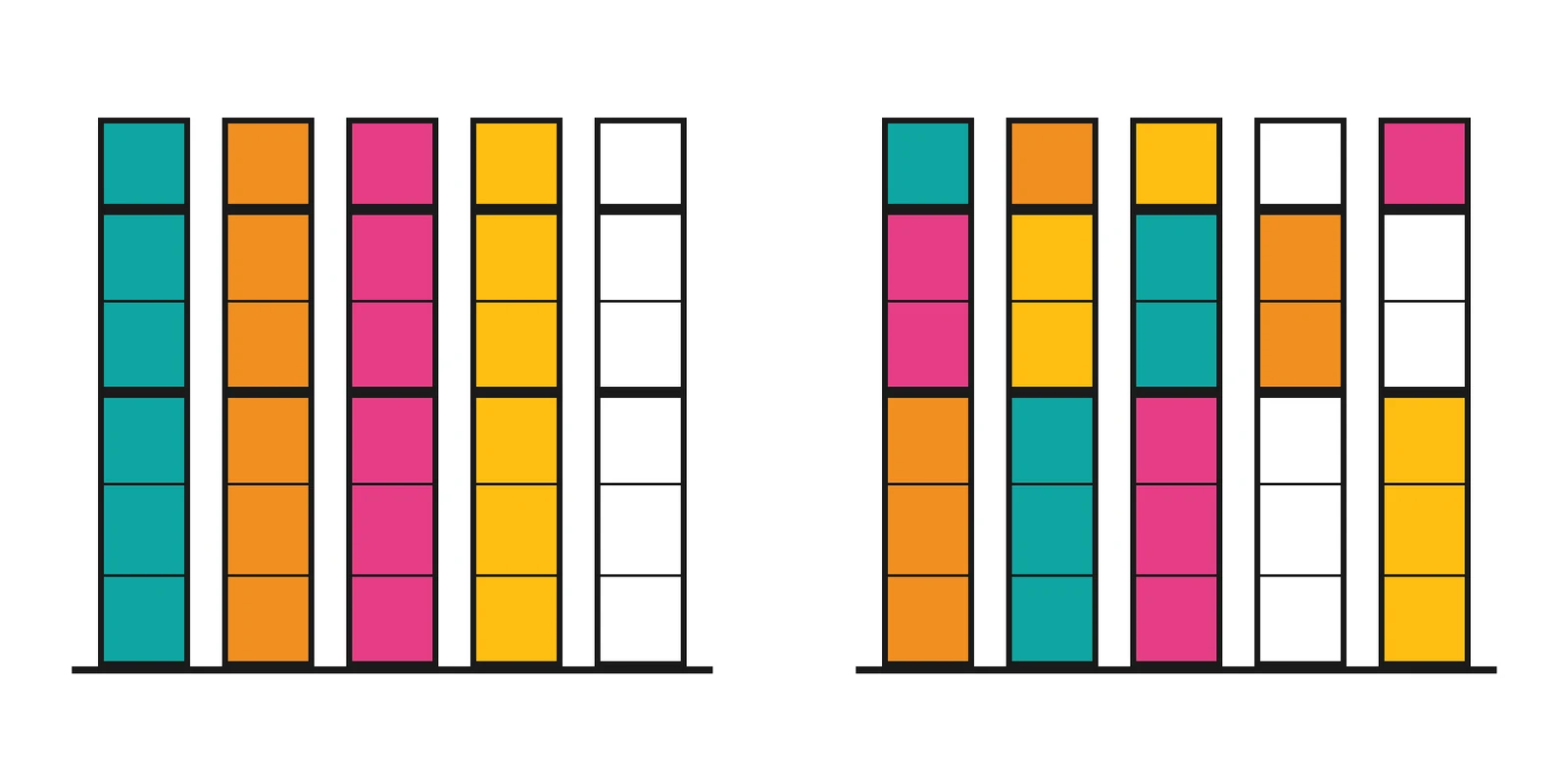
Tied group sizes make GroupKFold folds depend on the scikit-learn version and the CPU
In plain words
Grouped cross-validation splits data into folds and keeps each group, such as one patient's records, in a single fold, so no model is tested on a group it was trained on. Up to version 1.8, scikit-learn's GroupKFold put equal-sized groups into folds in an order that could depend on the numpy version and the processor. Version 1.9 gives the same folds on every machine, but when group sizes tie, its folds differ from those of earlier versions. In one project, the order of the equal-sized groups decided whether a statistical test, registered in advance, passed.
Abstract
GroupKFold, the grouped K-fold splitter of scikit-learn, sorts groups by size and deals them to folds. Up to version 1.8 it used numpy's default argsort, which does not fix the order of equal elements and whose SIMD kernels numpy chooses at run time from the CPU. Whenever two groups had the same size, the folds could therefore depend on the numpy version and the CPU. scikit-learn 1.9.0 (June 2026) sorts stably, which removes the CPU dependence but changes such folds relative to all earlier releases. The problem was reported and fixed upstream. We document its consequences. In one research project, 79 of 80 GroupKFold call sites had tied group sizes, and the non-stable orders moved 16 to 79% of the items to another fold. About 60 of the 188 fold-dependent claims of a paper draft changed at printed precision, one comparison reversed, and a pre-registered decision passed under one tie order (Holm-adjusted p = 0.022) and failed under another (p = 0.120). A self-contained example on the digits data bundled with scikit-learn reproduces the effect. In a pre-registered random sample of public code, 92.8% of GroupKFold uses (95% interval 86.8 to 98.8%) run without shuffling on groups whose sizes can tie. All 8 uses whose data we could rebuild had tied sizes, and in 5 the folds of versions 1.8 and 1.9 differ. We recommend storing folds as data, reporting library versions and checking decisions over several tie orders, and give a helper with a documented tie-break.