Copy and relatedness leaks in genomic language model benchmarks are common and can be found and largely removed automatically
In plain words
In some public tests for models that learn from DNA or RNA, the answer can be copied from a near-identical training example. The paper introduces seqleak, an automatic checker that finds such leaks. The checker was run on 41 tests that were not used to tune it. It flagged every one in which a manual audit had found copies or close relatives of training examples. For 60 widely used tests, the paper provides versions with fewer leaks.
Abstract
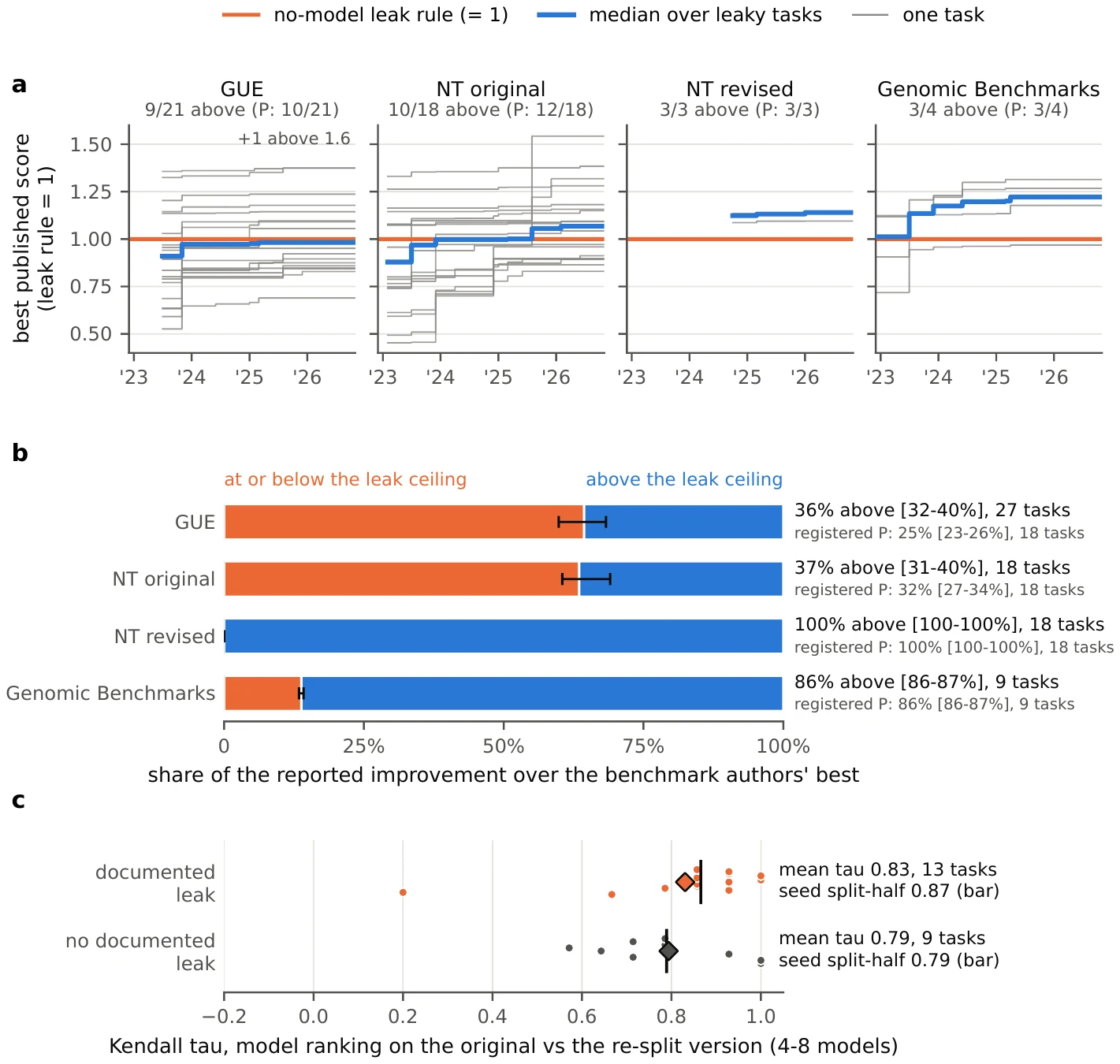
Genomic language model benchmarks rank models, but on some tasks a no-model rule, such as a nearest-training lookup that copies the label of the most similar training item, matches or beats the best published score. Such rules exploit leaks: test items that are copies or relatives of training items, negatives constructed from the positives, and genomic positions that reveal the label. Copies and relatives occur in 8 of the 11 DNA and RNA benchmarks published from 2024 to 2026 that we audited, although on most tasks no leak rule comes close to the published scores. The frozen rules of our linter, seqleak, recover all 24 copy and relatedness flags of that audit on 41 tasks not used to set them. In pre-registered fine-tuning experiments on GUE's yeast histone-mark tasks, however, relatives in training raise test scores only slightly on average. Constructed negatives are rarer, mostly draw only a warning from the frozen rules and survive re-splitting. Yet each of six models fine-tuned on GUE's constructed negatives instead of matched genome windows scores lower on matched genomic negatives, by 0.15 and 0.41 AUROC on average for shuffled and segment-substituted negatives, net of the same comparison on control tasks. On independent G+C-matched test sets the losses are 0.14 and 0.31, whereas an earlier independent test without G+C matching did not meet its registered criterion. About two thirds of the improvement reported on GUE and the original Nucleotide Transformer tasks since their release does not exceed a no-model leak rule's score, so published scores alone cannot tell it apart from leak exploitation; on Genomic Benchmarks, most of it lies above. We release the linter, leak-reduced versions of 60 tasks, of which the re-split ones remove most of the lookup's signal, and PairCtrl, a leaderboard that controls for genomic position.